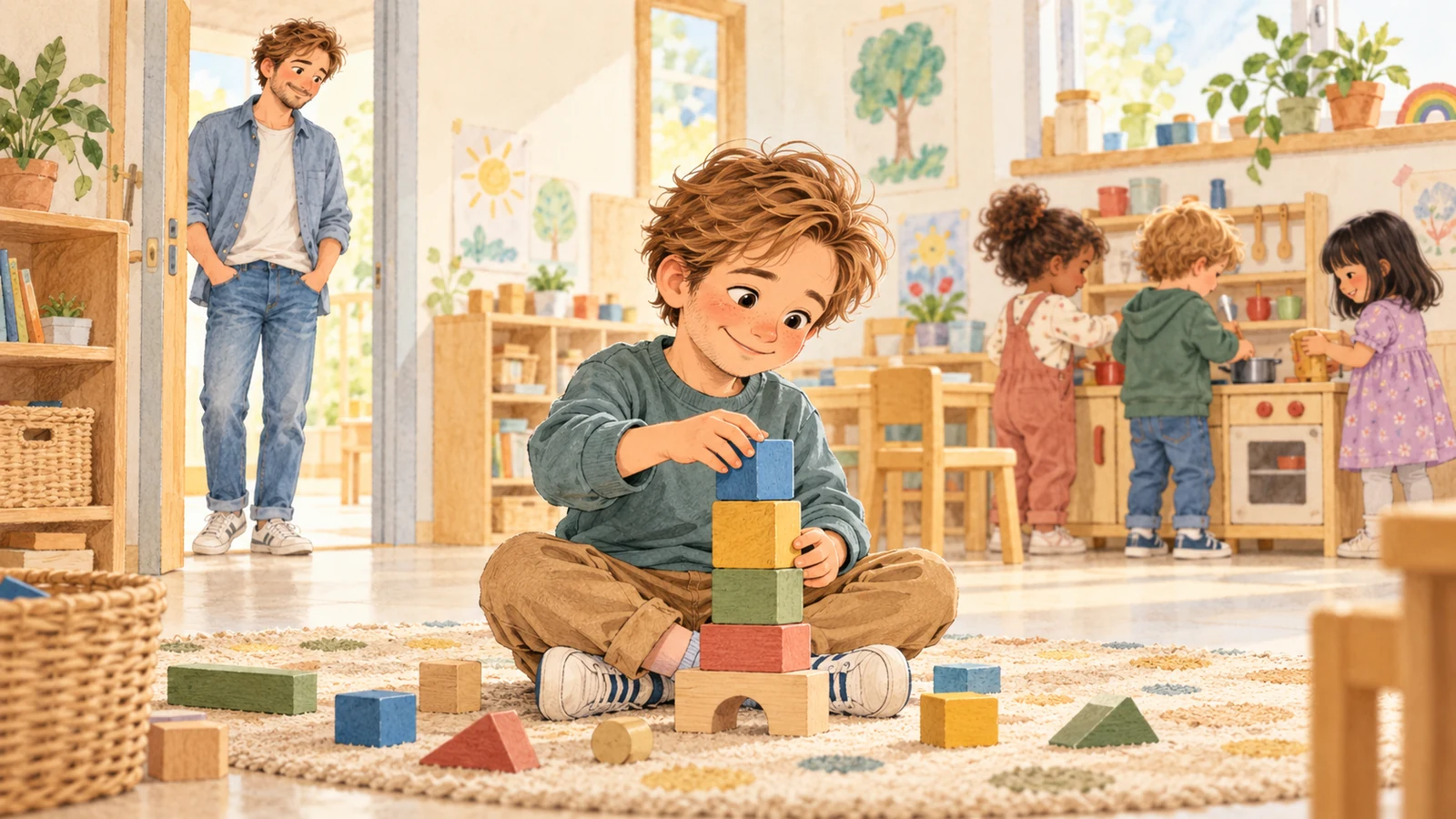
At the classroom door, I spotted Oscar, my four-and-a-half-year-old son, sitting on a small rug with some blocks. Three children were making a meal at the toy kitchen and another was rolling a toy lorry along. Oscar was slowly adding a block to a tower.
Seeing him play alone at preschool, I immediately started wondering what was wrong. Had he tried to join the others? Had they turned him away? I had come to pick up my son, but I was already preparing a serious conversation about his social life.
Oscar, meanwhile, was looking for a blue block.
Playing alone at preschool does not tell you about the whole day
His teacher explained that he had played at the toy kitchen with the others, then chosen the blocks. When I went over, Oscar asked me to wait: he wanted to finish his tower before leaving.
On this occasion, he seemed to have found exactly what he wanted. I would have felt more reassured to see him surrounded by other children. In my mind, a good day at preschool should end with a friend on either side and everyone playing the same game.
Yet enjoying other people’s company does not mean you never want to build something without discussing where every block should go. And sitting next to a group is no guarantee that you feel comfortable in it.
The question was not simply whether he played alone, but whether he could join the others when he wanted to.
Looking at what happens around him
A glimpse at pick-up time was not enough to answer that. Neither was his look of concentration. To understand, I needed to hear what Oscar could tell me and what the staff saw throughout the day.
Had he chosen to leave a game? Was he trying to join in without managing to? Did he sometimes play with other children, or was he regularly left on the sidelines when he wanted to take part?
We can ask about this without turning every pick-up into an investigation. A specific question to an adult who knows the child often tells us more than asking “Does he have friends?” while everyone is putting on coats.
"When he wants to play with the others, how does that go?"
"I've seen him on his own several times. Does he choose those moments, or does he need help to join a game?"
If a child describes being turned away repeatedly, or the staff see him trying without managing to take part, it is worth working together to help him join in. A quiet moment he has chosen, on the other hand, does not have to be filled at all costs.
That afternoon, I let Oscar add his blue block. Then he showed me his tower before putting on his coat.
I had almost sent him over to the others. What he needed most was a minute to finish.