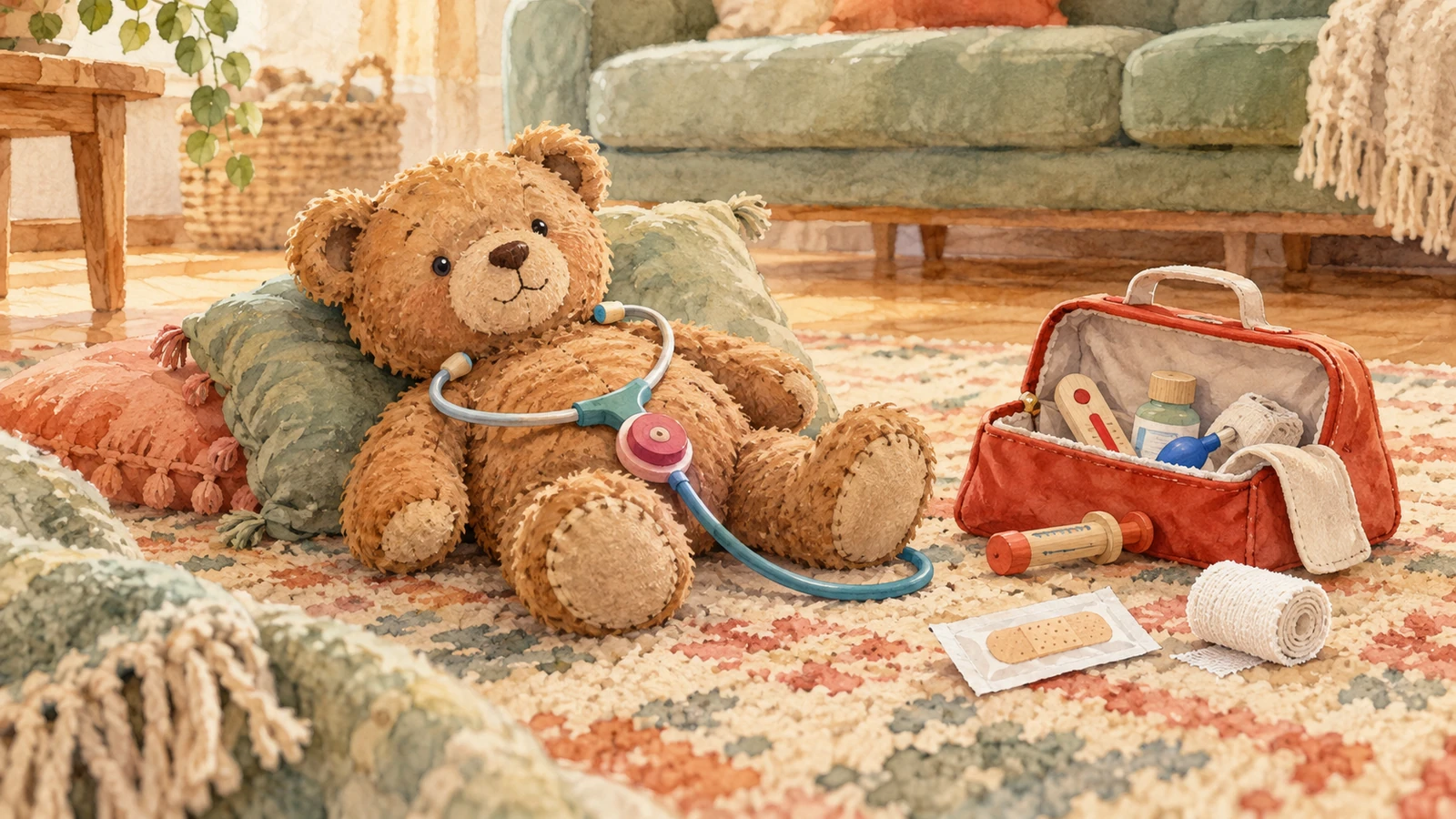
Oscar, my four-and-a-half-year-old son, had set up his surgery on the living-room rug. A soft toy was waiting on a chair, three building blocks served as prescriptions, and I had been summoned for an emergency.
I pointed to my knee. Oscar examined my elbow with his plastic stethoscope, then announced his diagnosis: I had sock disease. To get better, I had to swallow some invisible soup and hop twice on one foot.
I almost explained that this wasn’t how you treated a knee. It was hardly a properly regulated practice.
When your child takes charge of playing doctors
In pretend play, adults already know most of the rules of the real world. We know where to listen to a heartbeat, what a thermometer does and why you don’t treat an ankle with a spoon. Setting that knowledge aside can be surprisingly difficult.
Oscar wasn’t asking me for a believable consultation. He was handing out roles, inventing a story and checking that his patient was following along. With each new answer, he had to imagine what would happen next.
So I asked, very seriously, whether sock disease was contagious. He thought about it, picked up his bear and decided that it was, but only for soft toys that slept in the bed.
The doctor was improvising. So was his patient. And the game kept going.
Joining in without taking over
Letting a child lead the game doesn’t mean staying silent or agreeing with everything they say. I could ask questions, pretend to be frightened of an injection and even suggest a complication. The difference lay in what I did with his answers: accepting them as ideas for a game, rather than mistakes to correct.
When Oscar asked me to take the bear’s temperature with an imaginary banana, I didn’t explain how thermometers worked. I asked whether the bear had a fever. “A big one, but cuddles will cure it,” the doctor replied.
Of course, if we were discussing real medicine, an injury or an actual worry, I would give accurate information. Pretending doesn’t mean leaving everyday life muddled.
Two questions were often enough to enter his story:
“Doctor, what do I need to do now?”
“What if your patient can't follow the treatment?”
Oscar eventually let me get up. I asked whether I was cured. He examined my foot, frowned and decided I needed to stay lying down a little longer.
He wasn’t a very good doctor, really. But he knew exactly how to make an appointment last when his dad wanted to tidy the living room.
Keep this handy
The situation
Does your child invent impossible treatments when playing doctors?
Try this
Notice what your child is trying to do and leave room before offering another idea.
- “Would you like me to join in, or would you rather carry on?”
Keep in mind: Play does not need to be directed or turned into a learning activity every time.