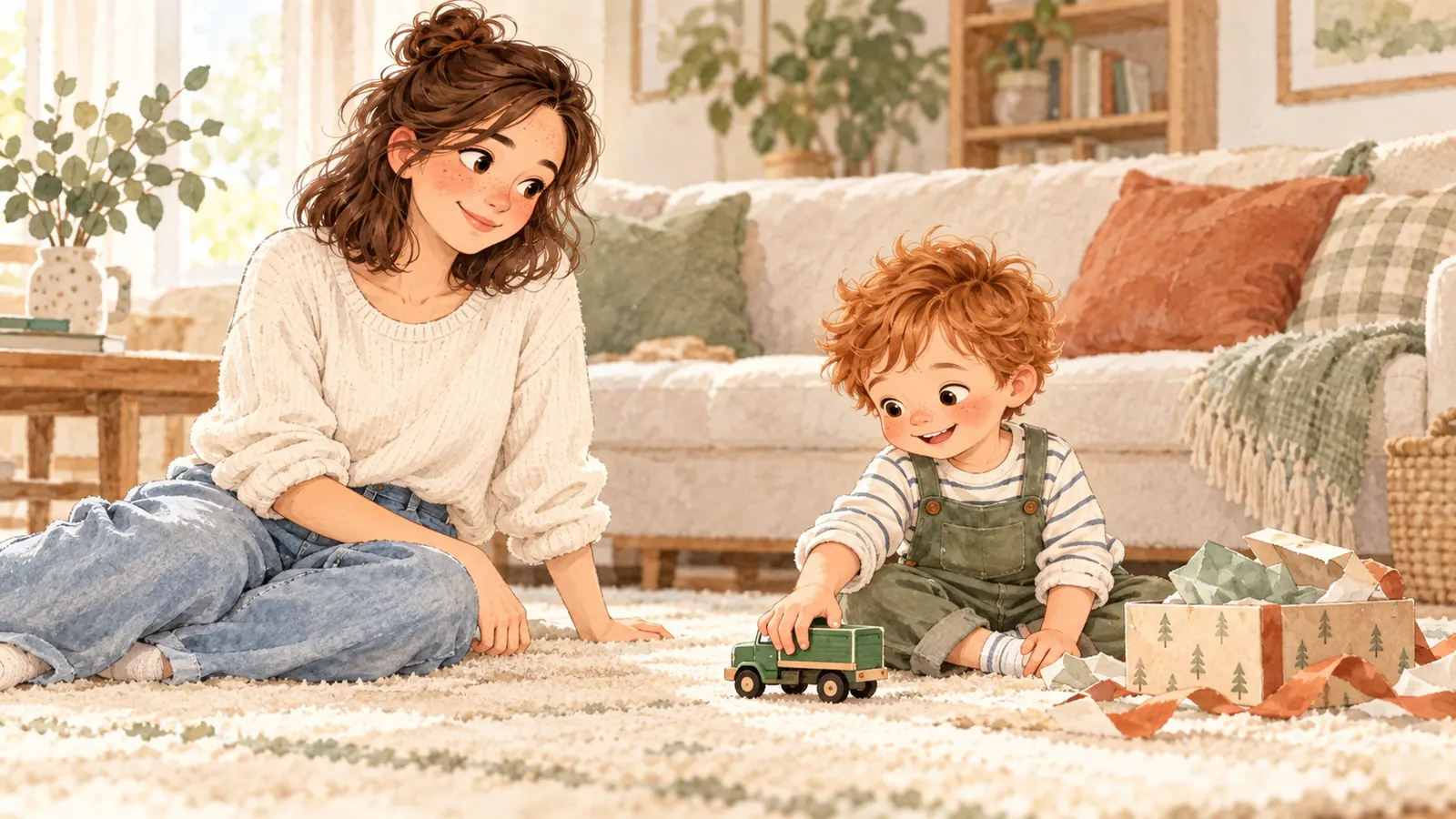
Malo had just opened a small present brought by one of Camille’s friends. A toy truck. Exactly the kind of thing capable of making the rest of the world disappear for several minutes.
He looked at it, put it on the floor and immediately crouched down to roll its wheels across the rug.
Camille waited one second.
Then two.
Her friend waited too.
“What do we say?”
Malo did not look up.
“Malo… we say thank you.”
“Thank you,” he finally murmured, already busy driving the truck under a chair.
The words were there. Camille was not sure the gratitude was.
How do you teach a child to say thank you without turning politeness into something they repeat on command?
Because the person in front of them matters too
Of course, letting somebody give a present without any response can feel unsatisfying as well.
That person chose something, bought it, wrapped it and brought it. They may want to know their gesture was noticed. And during those few seconds of silence, they may also wonder whether the child has never been taught to say thank you.
That is probably why we prompt the answer so quickly.
It is not only about appearances. We are also trying to teach an important social rule: when somebody does something for us, we acknowledge it.
The little bug is perhaps believing that getting the child to say the right words immediately is enough to teach everything behind them.
At nearly three, Malo may be so absorbed by the truck that he temporarily forgets the person who gave it to him. He can repeat “thank you” because he has been told to without yet fully connecting the words to the gesture he has just received.
We can do both
Camille does not have to choose between letting the moment pass and turning Malo into a candidate in a manners exam.
She can first take care of the person in front of her:
Then she can include Malo without expecting a perfect performance:
“Malo, Léa brought this truck especially for you. Let’s thank her.”
“Do you want to show her which part you like best?”
Later, once the excitement has settled, she can return to what happened: “Do you remember? Léa chose that truck especially for you.”
Perhaps that is where something really begins to grow: learning not only when to say thank you, but slowly understanding why.
Small social rules matter. We can teach them, remind our children and sometimes even speak for them when they cannot manage it yet.
But behind the word is a slower skill to build: noticing another person’s gesture.
At first, we sometimes help a child say thank you. Over time, what we really hope is that they understand what they are thanking someone for.