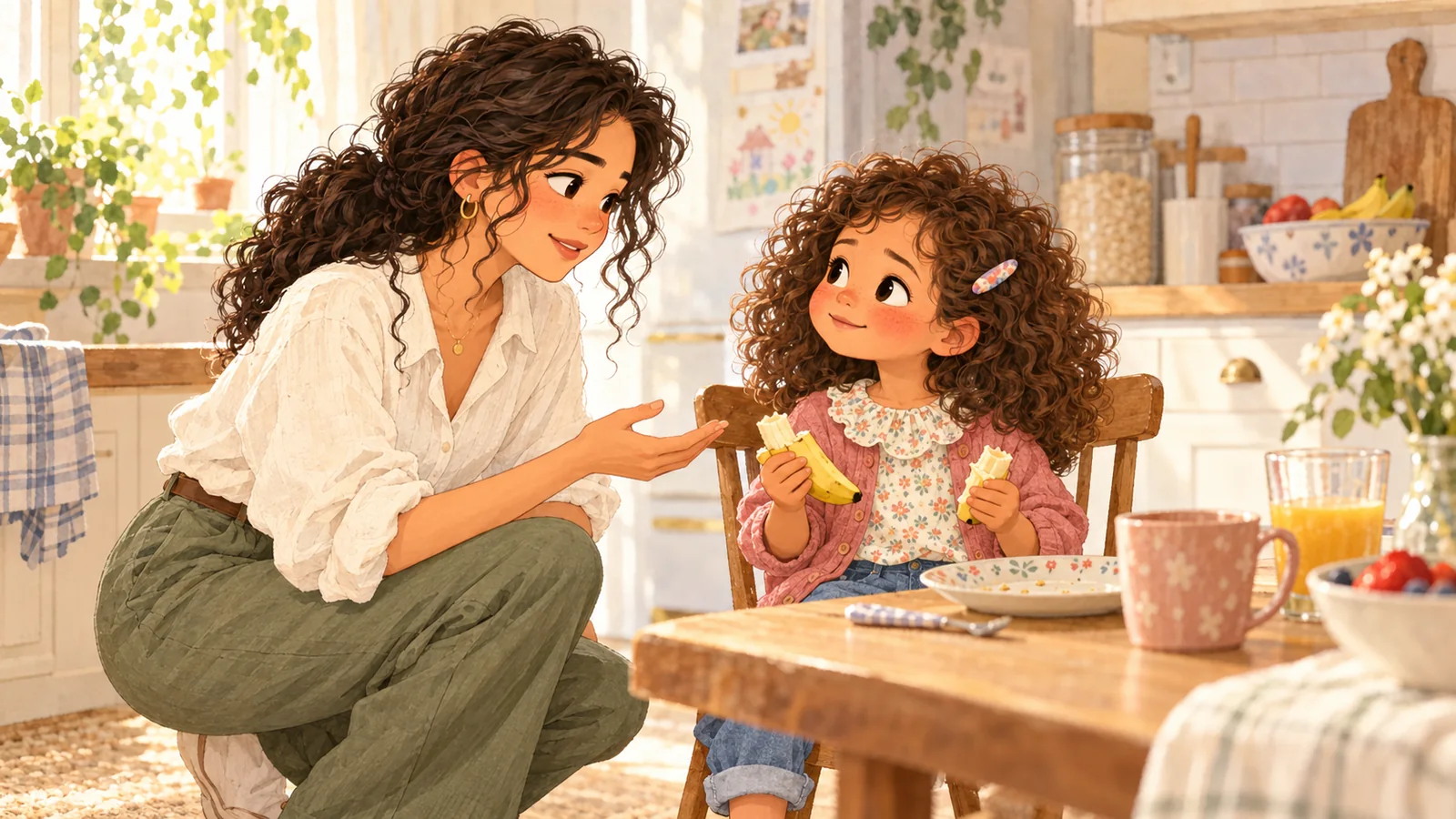
Iris, my three-and-a-half-year-old daughter, started crying because her banana had broken in two when I opened it.
I was standing up, coat on, bag over my shoulder, already late.
And I answered:
“There are worse things.”
The words came out on their own. They weren’t something I had chosen for her. They were words I had heard as a child.
The strangest thing was that I didn’t even mean what I had just said. At three and a half, a broken banana can absolutely feel like a breakfast disaster. Yet, when my patience was running low, I had reached for an old shortcut without even looking for it.
Why do our parents’ phrases sometimes come out automatically?
We can think carefully about how we want to raise our children, decide not to repeat certain things and still catch ourselves saying exactly the kind of phrase we wanted to leave behind.
It can feel uncomfortable. We immediately wonder: am I doing the same thing after all?
But one automatic phrase does not tell the whole story of how we parent. In that moment, I had little patience left and had fallen back on something familiar.
The problem wasn’t that I had “failed” at raising Iris. It was simply that the phrase didn’t match what I wanted to teach her.
I didn’t need to put my whole childhood on trial to see that.
You can repair a sentence after saying it
I wish I had found the right answer first time. But I could still do something much simpler: go back to it.
I crouched beside Iris.
“Wait. What I just said wasn’t very fair. You’re sad because your banana broke.”
She sniffed and showed me the two pieces as irrefutable evidence of the disaster.
Repairing the moment doesn’t have to mean starting a big conversation. Sometimes we can simply try again with the words we would rather have used.
“Let me try again. I can see how disappointed you are.”
“What I just said wasn’t helpful. Tell me what’s upsetting you.”
That doesn’t guarantee the child will stop crying, and that isn’t the point. The idea is simply not to let an automatic phrase be the last thing said about the moment.
Iris eventually ate both pieces of banana. They tasted exactly the same.
I had discovered something else: hearing an old phrase come out of my mouth didn’t mean I had to keep using it.