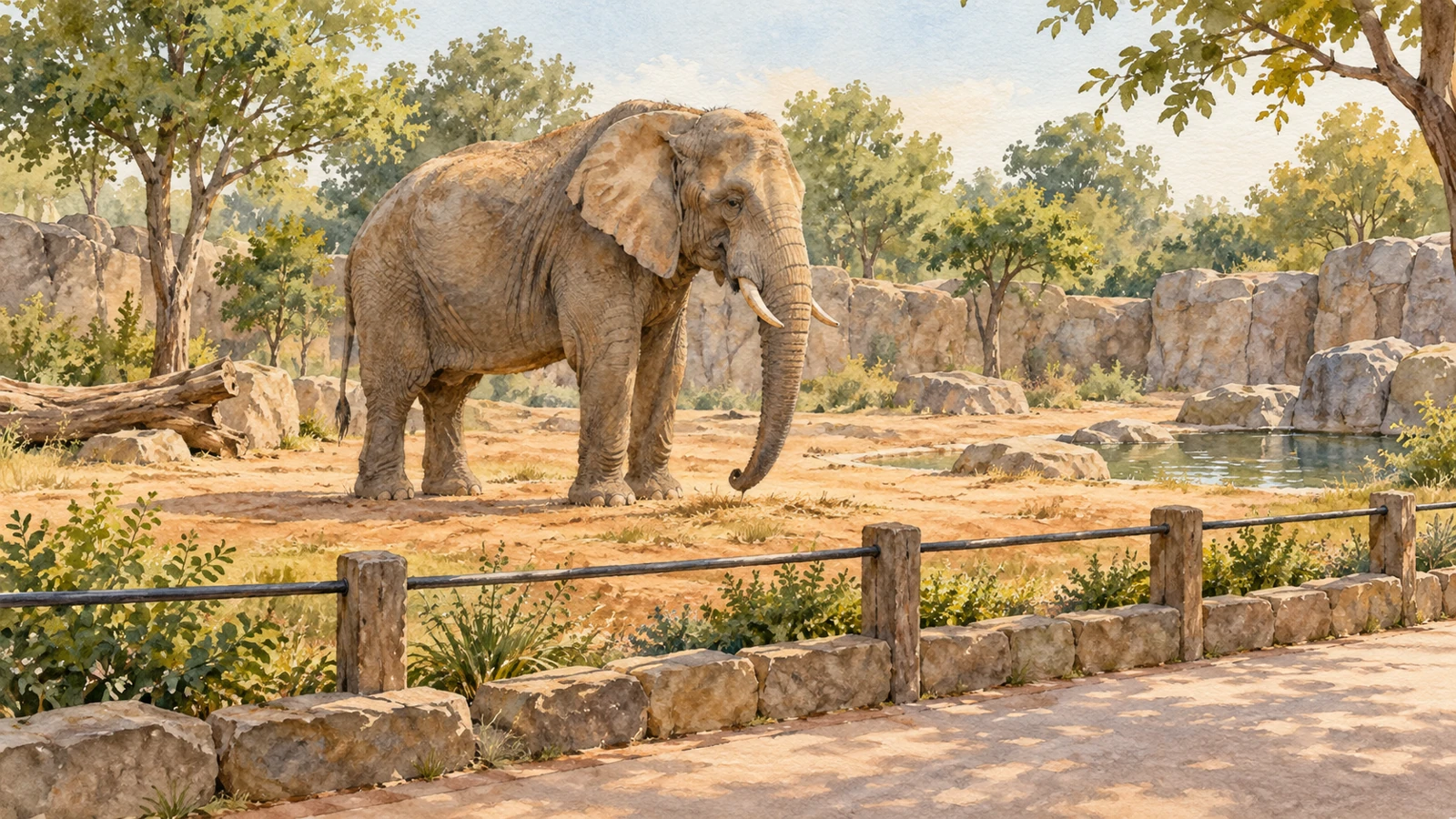
Louise, five, spotted the elephant before Élodie, her mum. She pointed out its trunk, its huge ears and the dust it stirred up. Élodie was mostly looking at the boundary between the enclosure and the path.
She had organised a zoo trip to discover animals with her daughter. Standing in front of them, she was already unsure what she was showing her.
Louise was asking about the fence. In Élodie’s head, there was suddenly an entire debate about zoos, wild animals and the outing she herself had suggested.
At the zoo, children are not always asking our question
Élodie could have replied that the elephant was very happy here to protect her daughter’s sense of wonder. Or immediately explained why she thought captive animals were unhappy to remain true to her doubts.
Either way, she would have asserted something she could not deduce from this visit alone. She would also have replaced Louise’s question with her own conclusion.
She could start more simply: the enclosure marks out the space where this animal lives here. The fence prevents it crossing the path to go elsewhere. The zoo’s staff look after it and that does not settle every question about its life.
Describing what is visible requires neither defending every establishment nor condemning them all together. Afterwards, they can seek specific information about the animal and this place’s conditions without inventing how it feels right now.
Leave room for two different perspectives
Élodie’s unease could coexist with Louise’s curiosity. Her daughter did not need to feel guilty for enjoying seeing the elephant.
Naming a doubt in accessible words also shows that an adult can think without immediately having a definitive answer. It does not turn the child into the judge of the adult’s contradictions.
Élodie could say:
“I enjoy looking at it with you and I have questions about the space it has to live in.”
“We can find out how elephants live in the wild and compare that with what we see here.”
Later, the family might choose another way to discover animals: books, suitable documentaries or observing species close to home. One past outing did not oblige them to make the same choice again.
Louise asked whether elephants walked a lot. Élodie said they would find out together. They left the enclosure with a specific question rather than an opinion Louise was expected to bring home.
Keep this handy
The situation
Your child is delighted at the zoo while the enclosures make you uneasy.
Try this
Answer their specific question, distinguish observations from assumptions and look together for information about animals’ lives.
- “I don’t know what this animal feels. Let’s see what we can learn about its life.”
Keep in mind: An adult’s doubts need not make a child give up their curiosity or immediately adopt a verdict.