
IN-DEPTH GUIDES · EMOTIONS · AGES 2 TO 5
Why do children find it so hard to manage their emotions?
Recognising, understanding and regulating: three skills that develop throughout childhood and help explain some puzzling reactions.

Your child knows perfectly well that they're angry, yet they keep screaming. They understand that hitting isn't allowed, but their hand lashes out anyway. And sometimes a disappointment that seems tiny to us is enough to trigger a spectacular meltdown.
These reactions can be exhausting, especially when it feels as though we've already explained everything.
But they make more sense when we distinguish three skills children develop gradually: recognising their emotions, understanding what causes them and learning to regulate their reactions.
These skills are connected, but they don't necessarily progress together. A child may know exactly why they're upset and still be unable to calm down.
What does research tell us about these skills? How do they explain some of our children's more baffling moments? And, above all, how can we help without turning every disappointment into a psychology lesson?
Recognising emotions: learning to identify what we feel

Children experience emotions long before they can name them.
A baby can show distress, joy or discomfort without having any idea what the word “frustration” means. Even after children begin talking, they need time to tell different feelings apart.
Anger, sadness and fear aren't always easy to distinguish, particularly when they overlap.
Is a child who cries because a classmate won't play with them sad? Angry? Disappointed? Perhaps a little of all three.
What the research tells us
In 2025, researchers examined emotion recognition skills in 1,285 children aged three to five [1].
Among other tasks, the children saw faces showing different expressions and were asked to identify happiness, anger, sadness or fear.
Three-year-olds could already recognise some expressions. In this task, anger and sadness were among the expressions they identified most successfully. Fear was generally harder to recognise.
Performance improved with age, though the different emotions weren't all equally easy to identify.
That highlights something important: emotion recognition develops gradually. Children don't suddenly become able to distinguish every feeling at once.
And recognising an expression in a picture doesn't necessarily mean being able to identify your own feelings, particularly in the middle of an upsetting experience.
What this explains about everyday parenting moments
Imagine Gabriel crying because he can't take a toy home. When someone asks what's wrong, he simply replies, “I want the truck!”
He's expressing what he wants perfectly clearly. But that doesn't tell us whether he can distinguish disappointment from anger.
And when a child shouts “I hate you!” after being disappointed, it isn't necessarily a considered, accurate description of how they feel about their parent.
They may simply be trying to express the intensity of their frustration using the words they have.
How parents can help
One of the simplest things we can do is offer words for what a child seems to be feeling, without insisting that our interpretation must be right.
- “You're disappointed. You really wanted that truck.”
- “Did the dog barking frighten you?”
- “You look so proud of your tower!”
- “I'm not sure whether you're sad or angry. Would you like to tell me?”
We don't have to wait for a meltdown. Happy moments are lovely opportunities to talk about feelings too.
And when a child disagrees with our interpretation, we can simply listen. After all, we aren't always the best people to know exactly what they're feeling.
The key idea: before children can explain or manage their emotions, they gradually develop the ability to identify and express them.
Understanding emotions: discovering why we feel something

Recognising sadness on a face is one thing. Understanding why somebody feels sad is another.
That means connecting a feeling to a situation, a wish, an expectation or sometimes a disappointment.
To an adult, the connection often seems obvious. To a young child, it may be far less clear.
What the research tells us
In the same 2025 study, researchers gave the children a second set of tasks [1].
This time, they had to work out what a character might feel in a particular situation.
The results were revealing: children generally found it easier to recognise emotions on isolated faces than to identify and name them from a situation.
At age three, matching an emotion word to a situation was particularly difficult. Four- and five-year-olds generally performed better.
Other research on emotional development suggests that understanding the external causes of emotions emerges relatively early, while explanations involving beliefs, intentions or conflicting emotions develop over a longer period of childhood [2].
In other words, recognising sadness doesn't mean understanding all the different reasons why someone might be sad.
What this explains about everyday parenting moments
Louise, aged five, comes home from school announcing that Zoé isn't her friend any more.
Why? Because Zoé chose to play with another child.
To Louise, this may feel like rejection. But perhaps Zoé simply wanted to try a different game.
The two children may have experienced the same event quite differently.
That's the heart of our story about early friendships.
Another example is Gabriel and his snowplough toy. To an adult, deciding not to buy a toy is entirely ordinary. To a child who had already imagined playing with it, it can feel like the collapse of a deeply cherished plan.
Emotions depend not only on what happened, but also on what the child was hoping for.
How parents can help
We can help children see the connections between their feelings, their expectations and what happens around them.
- “You thought Zoé would play with you. You felt disappointed when she went away.”
- “You wanted to finish your drawing and I asked you to tidy up. Stopping is frustrating.”
- “You were happy to see your friend, and now you're sad that he's leaving.”
- “Maybe Zoé just wanted to play something different. It doesn't necessarily mean she doesn't want to be your friend.”
These conversations are often easier when a child is ready to engage, rather than in the middle of a big outburst.
Books, games and made-up stories also give us ways to explore feelings without talking directly about the child.
We might ask, “Why do you think he's crying?” or “What do you think she was hoping would happen?”
The point isn't always to find the right answer, but to encourage children to consider different explanations.
The key idea: understanding an emotion means gradually discovering the connection between what happens, what we expect and what we feel. It also means learning that other people can experience the same event differently.
Regulating emotions: knowing how you feel isn't the same as calming down
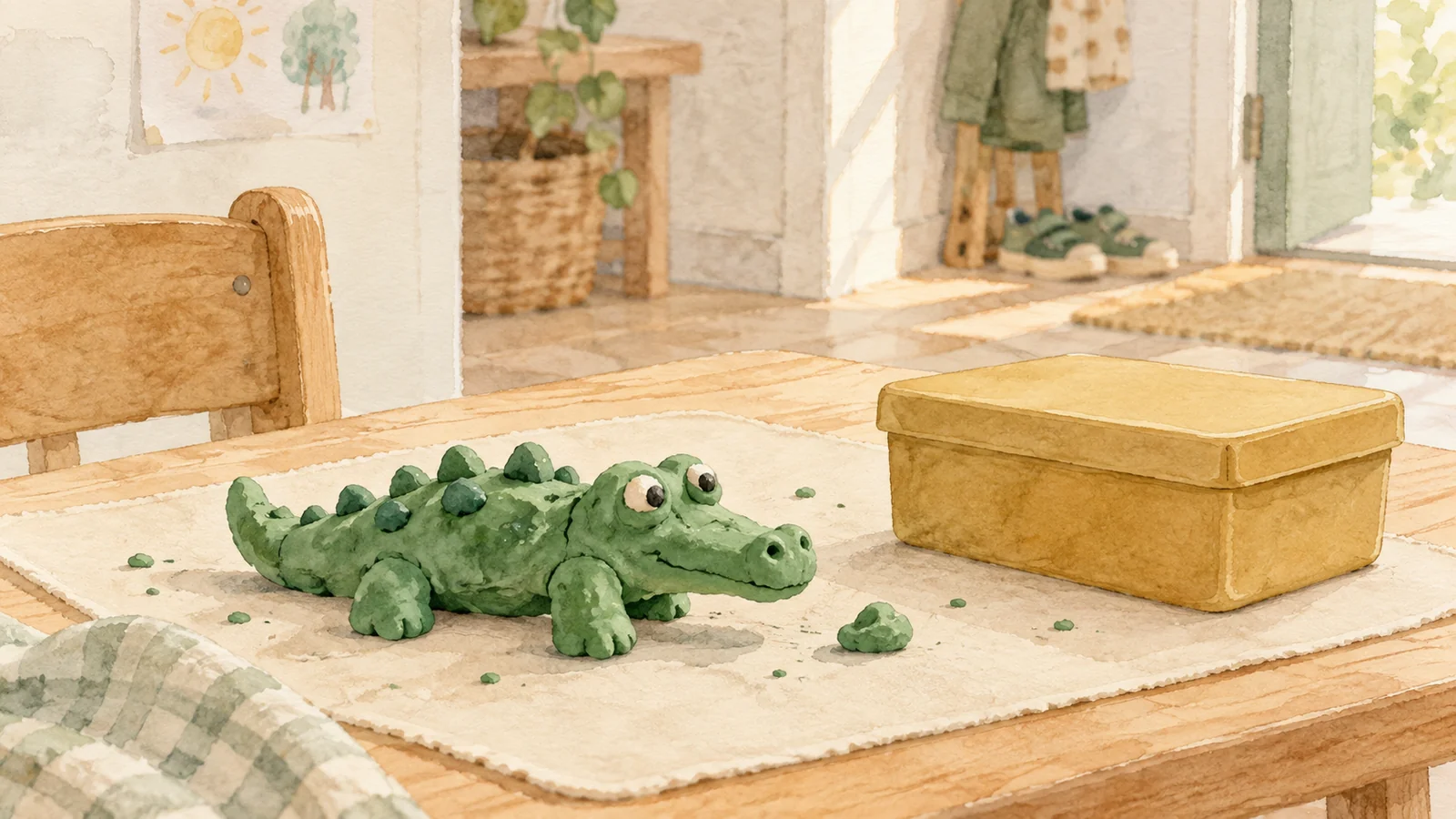
For parents, this is probably the most important distinction.
Malo, who is nearly three, can explain exactly why he's angry: his mum put the play dough away before he'd finished making his crocodile.
He knows what happened. He knows what he wanted. He can even say that he's angry.
Yet he keeps demanding the box and tries to grab it back.
In our story about Malo and his crocodile, that gap is particularly striking.
Understanding an emotion doesn't yet mean being able to change how you react.
Why is it so difficult?
Emotional regulation draws on several abilities: shifting attention, resisting an impulse, tolerating frustration and finding another way to respond.
These skills develop gradually throughout childhood.
Context matters too. A child who waits patiently in the morning may find it much harder in the evening when they're tired, hungry or already overwhelmed.
That is why progress isn't always steady.
And it's also why repeating an explanation doesn't necessarily end a meltdown.
What does research say about parental support?
Here, we have research that goes beyond simply observing how families behave.
In a trial published in 2010, 216 parents of children aged four to almost six were randomly assigned either to an emotion-coaching programme or to a control group [3].
The parents in the programme learned, among other things, to recognise emotions, talk about them with their children and respond in ways that were less dismissive.
After the intervention, researchers observed improvements in children's emotion knowledge. Parents and teachers also reported reductions in some behavioural difficulties.
A 2023 review of 15 randomised trials found average positive effects of several emotion-coaching programmes on children's emotional competence [4].
These findings don't prove that a particular phrase will calm a child down. The programmes combined different practices and their effects varied.
But they do suggest that helping parents support children's emotions more effectively can genuinely benefit children's emotional skills.
How parents can help during a meltdown
When a child is overwhelmed, the immediate goal isn't necessarily to help them understand why their behaviour is a problem.
They may first need help finding their way back to calm.
This support, sometimes called co-regulation, can take different forms: a reassuring presence, fewer distractions, a calmly held boundary or simply time.
In our story about the snowplough, Gabriel stays upset for almost 45 minutes after being told no. His mum tries several approaches before a water bottle speaking in a silly voice finally makes him smile.
Humour isn't a universal solution, but the story reminds us there isn't always an instant answer.
A few phrases that may help
- “I can see you're very angry. I'm staying with you.”
- “It's okay to feel angry, but I won't let you hit.”
- “You wanted to keep playing. Stopping is hard. The play dough is staying put away.”
- “We can talk about it again when you're ready.”
These aren't magic words. They acknowledge what's happening, maintain necessary boundaries and offer support.
If a child doesn't want to talk or be touched, there's no need to insist.
And once things are calm?
That's often a better moment to reflect together.
Malo's mum, for example, might come back to what happened:
“You were really angry when I put the play dough away. Next time, maybe we could take a photo of your crocodile so you can finish it later.”
The child discovers that disappointment can remain while they find another way to act.
Parents can also model how they handle their own emotions:
“I'm starting to get frustrated. I'm going to take a minute before we carry on.”
This doesn't require perfect calm in every situation. It's about showing that everyone has emotions and that we can learn how to respond to them.
The key idea: emotional regulation doesn't mean never feeling angry or sad. It means developing, with time and support, the ability to experience those feelings without being completely carried away by them.
Understanding feelings so we can support our little bugs
When a child has a big meltdown, we often look for the perfect explanation or the perfect phrase that will help them calm down.
But another explanation isn't always what's needed.
A child may still be learning to identify what they feel. They may recognise their anger without knowing precisely what triggered it. Or, like Malo, they may understand exactly why they're upset without being able to stop themselves.
These three skills don't develop like steps on a staircase. They grow together, at different rates.
For parents, understanding the distinction changes how we respond. Sometimes our child needs words; sometimes they need help making sense of what happened; sometimes they simply need an adult beside them while the feeling runs its course.
And very often, they need a little of all three.
The goal isn't to teach children never to get angry. It's to help them understand what they feel and, little by little, learn what to do with it.
Scientific references
- Richard et al. (2025). The development of specific emotion comprehension components in 1285 preschool children. Scientific Reports. Study of emotion recognition and understanding in children aged three to five.
- Pons, Harris & de Rosnay (2004). Emotion comprehension between 3 and 11 years: Developmental periods and hierarchical organization. European Journal of Developmental Psychology. Research on the development of emotional understanding.
- Havighurst et al. (2010). Tuning in to Kids: Improving emotion socialization practices in parents of preschool children. Journal of Child Psychology and Psychiatry. Randomised trial of a parent programme.
- England-Mason et al. (2023). Emotion socialization parenting interventions targeting emotional competence in young children. Clinical Psychology Review. Meta-analysis of 15 randomised trials.
Related everyday parenting stories
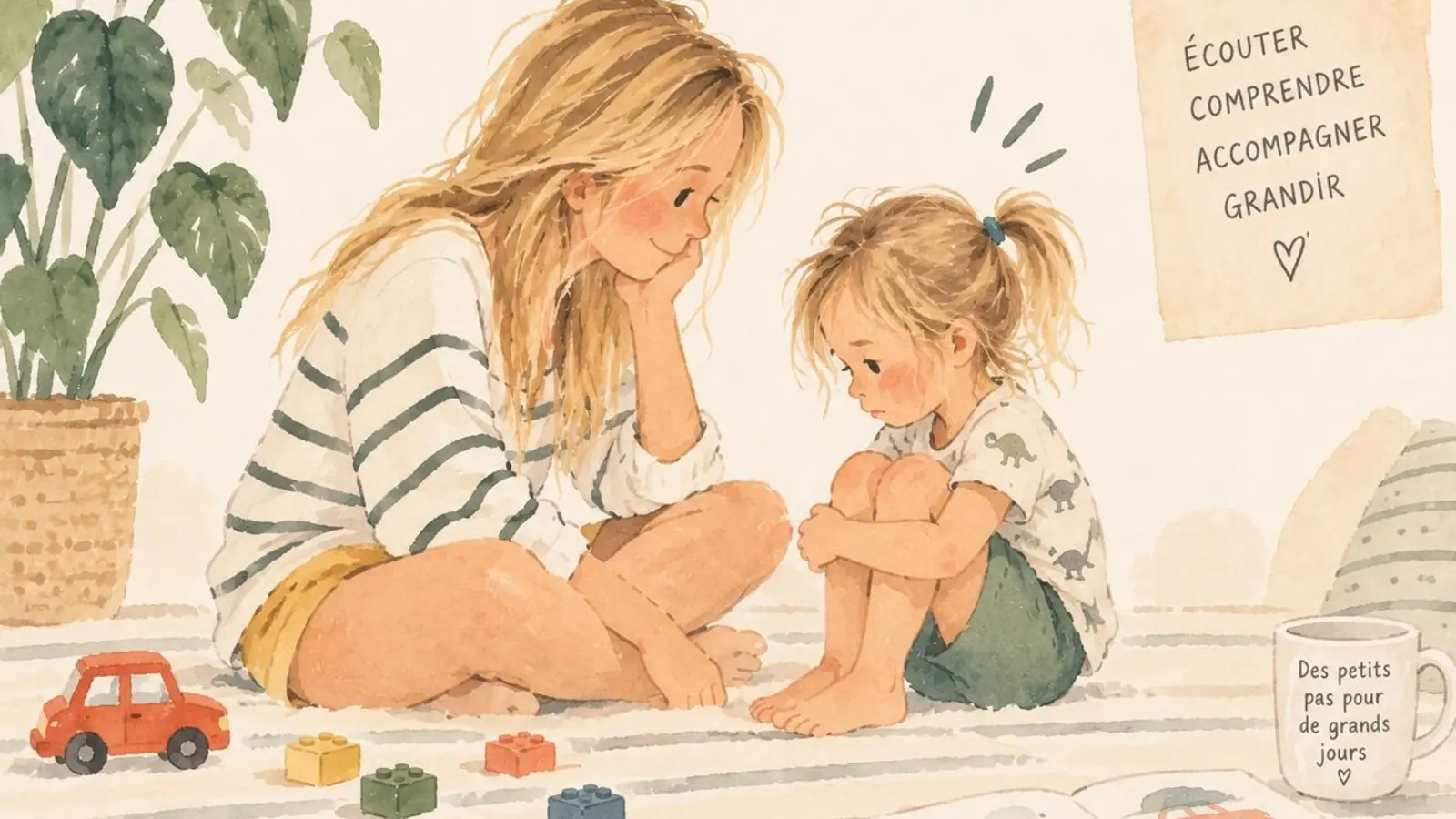
Before we correct, let’s start by listening
Is your child overwhelmed? Before correcting, explaining or finding a solution, acknowledging the feeling can help lower the tension.
When feelings are too big for words
Is your child overwhelmed by a big feeling? Drawing, playing, moving or tearing paper can give that emotion another way out.
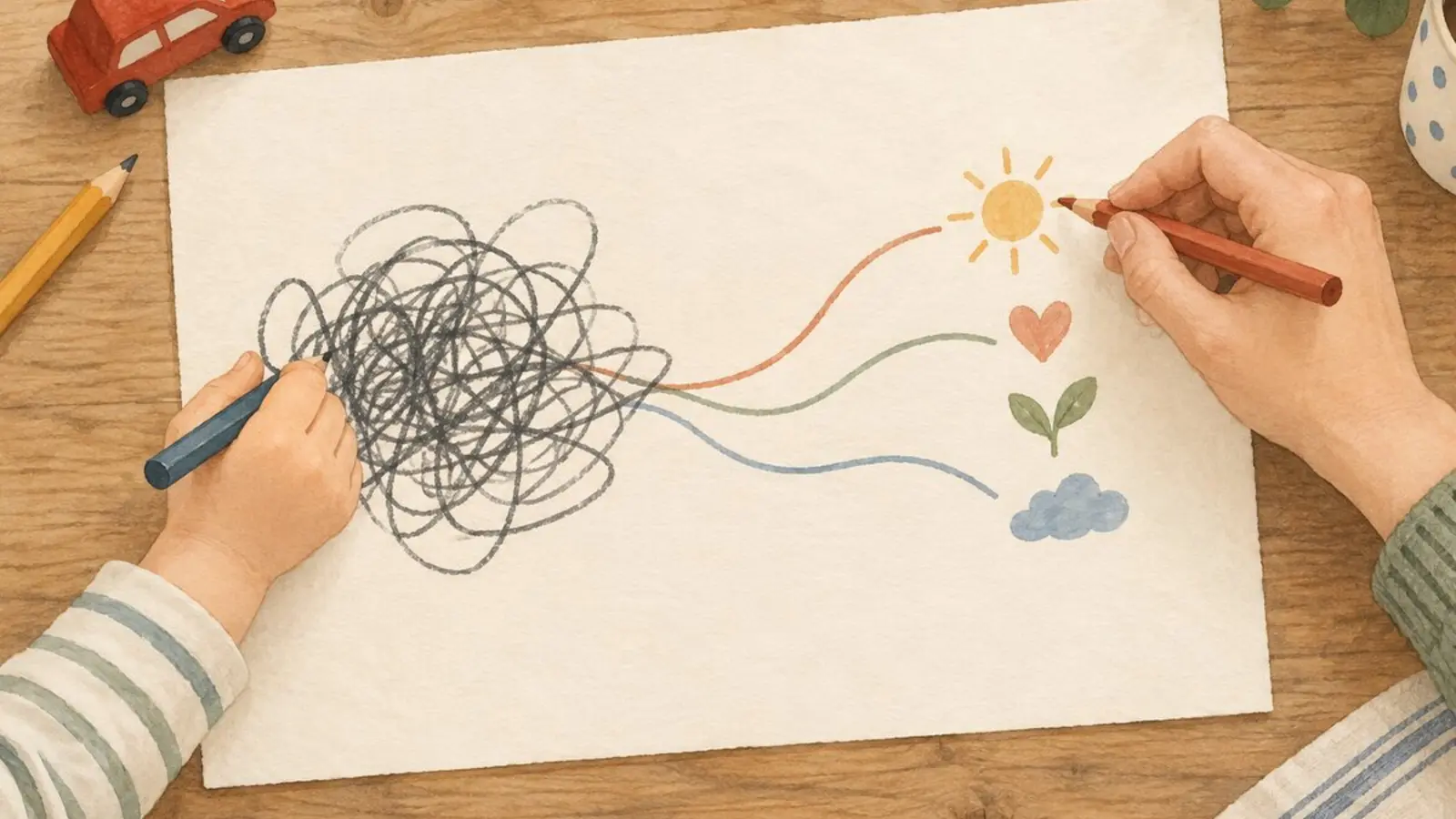
When the words won’t come, let’s write them down
Is your child struggling to talk about how they feel? Writing, drawing or making a list can help them express emotions another way.