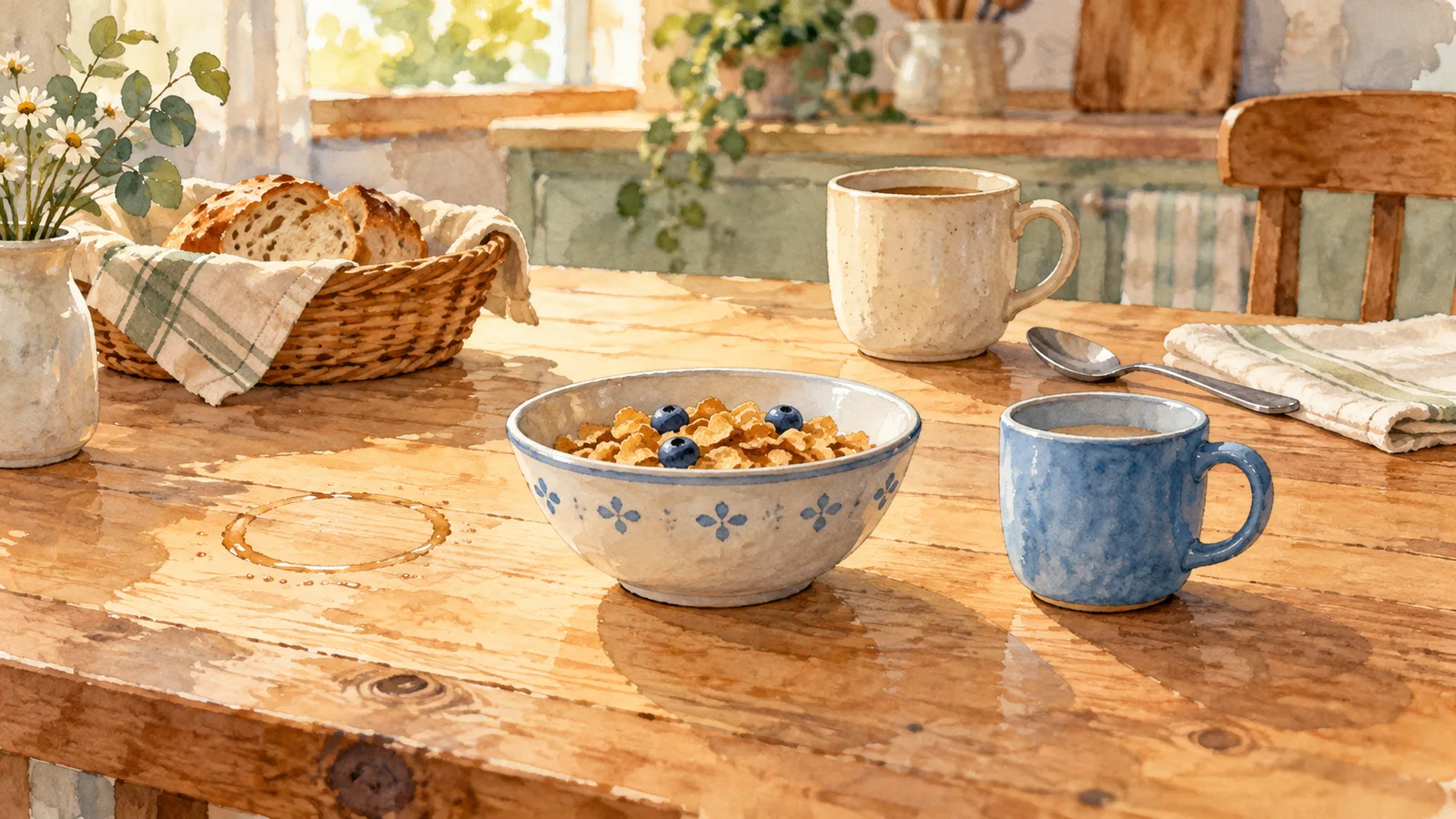
I had cleared a corner of the table for the bread basket. I had moved my cup, then Malo’s, my almost-three-year-old son. His was now to the right of his bowl instead of the left.
He sat down, looked at breakfast and announced that it was not in its place. I replied that it was the same cup, with the same milk.
My child was protesting because a small habit had changed. I was explaining that the amount of milk had not changed. That was clearly not the detail he was checking.
The small detail a child has already noticed
Malo showed me where I put his cup every morning. I realised that he knew this arrangement better than I thought. The bowl in front of him, the cup on the left and the spoon on the napkin: he did not need me to recite the plan.
For me, moving things was about space. For him, there was an order he already knew, and that morning I had changed it without warning.
That did not mean every protest hid a great worry, or that we needed to keep the table exactly as it was. But before calling his insistence a fixation, I could notice what he had just noticed.
He was not asking for a new bowl or a different drink. He was telling me that something was no longer as usual.
Naming the change without promising nothing will change
There was no particular reason for the basket to stay there. I put the cup back on the left and moved the bread. Breakfast resumed, without a demonstration of the need to be flexible before eight o’clock.
On another morning, I might not have been able to put things back. A cup can be in the dishwasher, a chair occupied and a route different. Acknowledging a familiar marker does not mean we can always restore it.
When a change is necessary, we can announce it simply and keep one familiar element if possible. The explanation does not guarantee the child’s agreement; it only avoids answering that nothing has happened.
“You noticed correctly, I put your cup on the other side to make room for the bread.”
“Today, the blue cup is being washed. You’ll have the green one, with your usual bowl.”
I can also give him a small role in setting things out without making him the guardian of all our habits. Putting down his spoon, yes; checking that nobody ever moves anything, no.
The next day, Malo put his cup down himself. On the left. I put the bread a little further away.