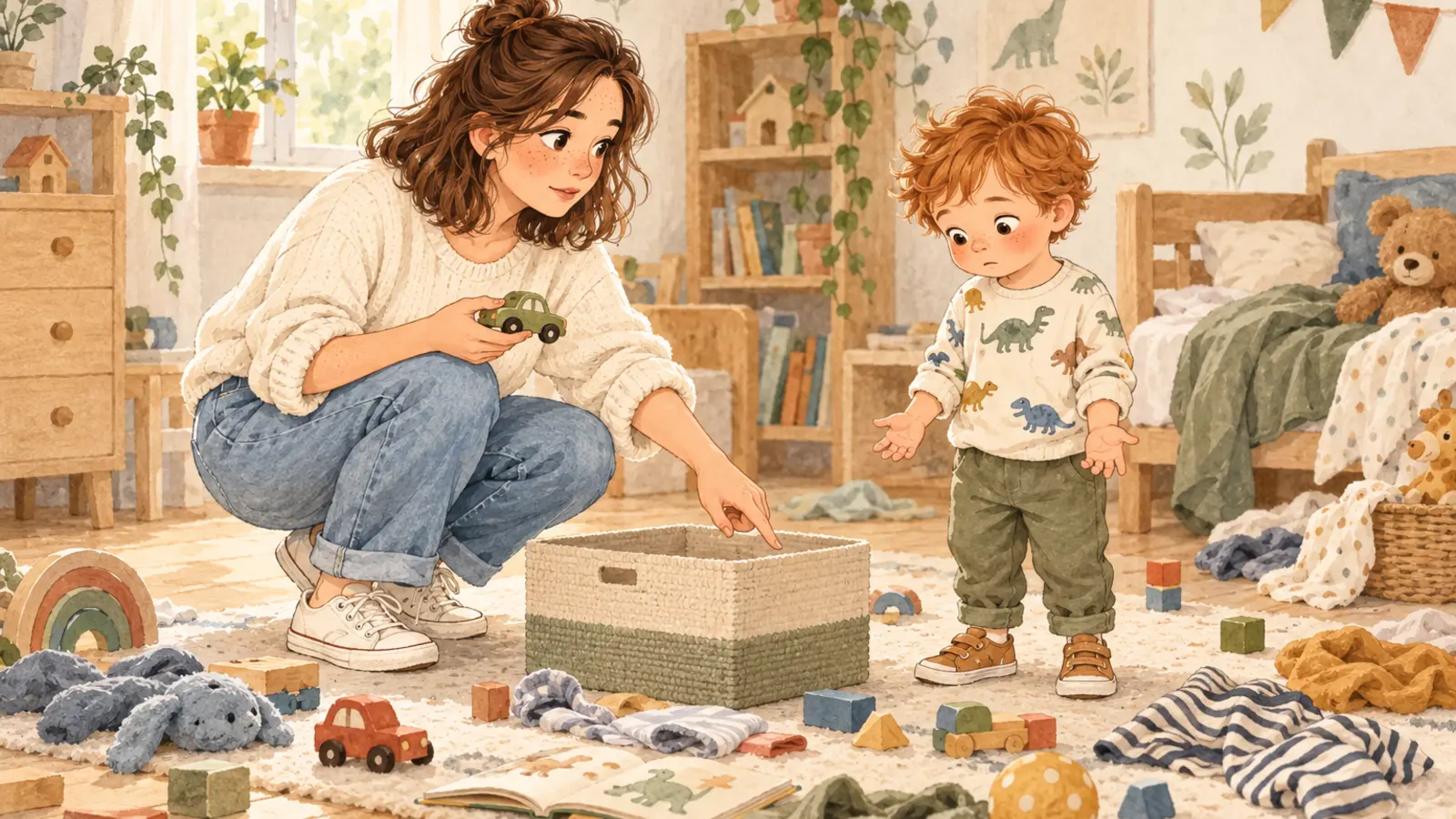
After dinner, I asked Malo, my almost three-year-old son, to tidy his whole room. I could see cars, clothes and books on the floor. He stayed in the middle.
At first, I read this stillness as refusal. I thought I’d given a very clear instruction.
Then he picked up a slipper and asked where it went.
Perhaps he wasn’t trying to escape tidying. He was looking for an address for the first object.
“Tidy your room” contains several tasks
In my head, the tidy room already existed: books on the shelf, clothes in the basket and vehicles in their box. I’d forgotten my sentence described none of that.
It asked Malo to spot categories, choose an order and know when he’d finished. The word “tidy” wrapped the whole programme into one instruction.
I could wait longer for his response, but waiting wouldn’t teach him where to put the slipper. This time, it wasn’t only about giving him time to hear. I needed to make the task less enormous and its result visible.
I crouched beside him. We looked for the cars, then their box. It was stuck behind a basket: even the destination wasn’t really available.
A first action with somewhere to finish
I pulled out the box and put the laundry basket beside the door. No need to redesign the whole room or buy a perfect storage system. Two accessible containers were enough to begin.
“Put the cars in this box. I'll pick up the clothes.”
Malo found one under the bed. Then he wanted to drive it to its destination. Tidying hadn’t stopped being slow because my sentence was more specific.
I didn’t add books and slippers in the middle of his first mission. Once the cars were together, we looked at what came next.
That evening’s goal could stay modest: a clear path and the bulkiest objects put back. Sorting every small piece could wait until we were less tired.
That didn’t mean Malo would never refuse a task he understood perfectly. But before raising my voice, I could check whether he knew what to pick up, where to put it and what would count as finished.
He finally placed his slipper beside the other one.
I’d asked him for a tidy room. We’d started by giving things a destination.
Keep this handy
The situation
Your child stands still when you ask them to tidy their room.
Try this
Notice what your child is trying to do and leave room before offering another idea.
- “Would you like me to join in, or would you rather carry on?”
Keep in mind: Play does not need to be directed or turned into a learning activity every time.