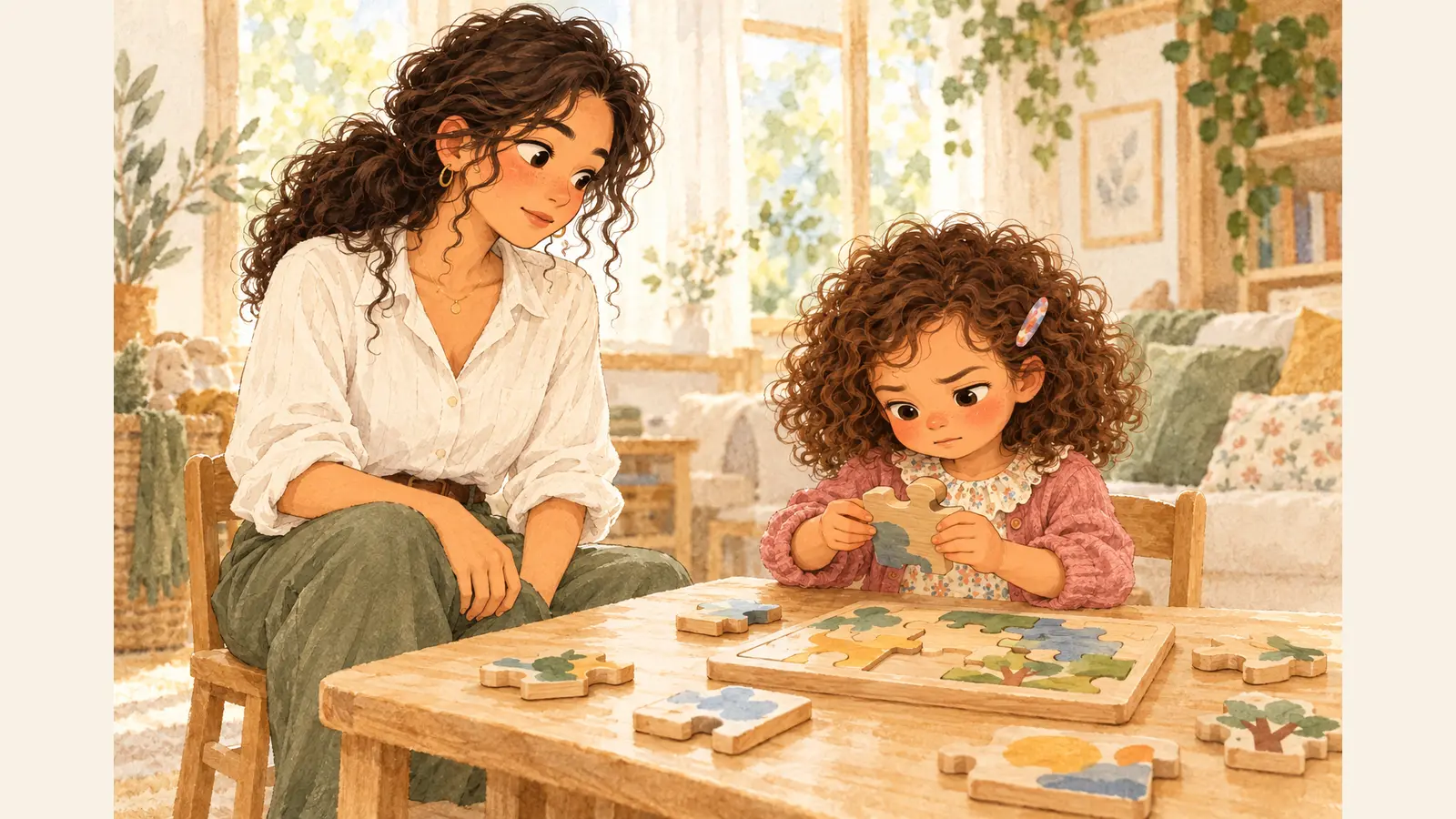
Iris, my three-and-a-half-year-old daughter, was pushing a puzzle piece into a space that looked very much like it. Except for one detail: it was facing the wrong way.
My hand was already moving. I could see the solution, the quarter-turn and the satisfaction that might follow.
Then I waited about ten seconds. Not because I was following an exercise. I simply noticed that my daughter was still searching.
My help arrived before her request
Iris picked up the piece again, looked at the picture and tried another way. She hadn’t found it yet. Still, something was happening in that hesitation I was about to interrupt.
On my side of the table, the mistake had become a small problem to remove. On hers, perhaps it was still an interesting question.
I didn’t need to know her exact thinking to leave her room to finish that action.
That didn’t mean watching a child struggle until they cried. There was no danger, urgency or great distress here. We had time and the puzzle could wait on the table.
In another situation, I could have helped straight away. The important thing wasn’t to respect a duration but to see whether my hand answered her need or mostly my impatience with a difficulty that was easy for me.
Stay available without taking over the whole action
When Iris looked up at me, I asked whether she wanted a clue. She agreed. I pointed to the colour at the edge of the picture without touching the piece.
She turned it once more and put it down. She could also have asked me to place it myself. Receiving help wouldn’t have cancelled what she’d just tried.
“Would you like to keep trying, have a clue or get some help?”
I could offer that choice without repeating the question for every piece. Sometimes staying beside her and waiting for a look was enough.
Nor did I want independence to become a new objective to defend against her. If she simply wanted to do the puzzle with me, we could share the pieces instead of making every gap an exam.
Iris continued for a few minutes, then handed me a piece.
“That one’s yours.”
I’d waited to let her do it. She’d just decided we could do it together too.
Keep this handy
The situation
Your hand is already reaching to help your child?
Try this
I could offer that choice without repeating the question for every piece.
- “Would you like me to join in, or would you rather carry on?”
Keep in mind: Play does not need to be directed or turned into a learning activity every time.