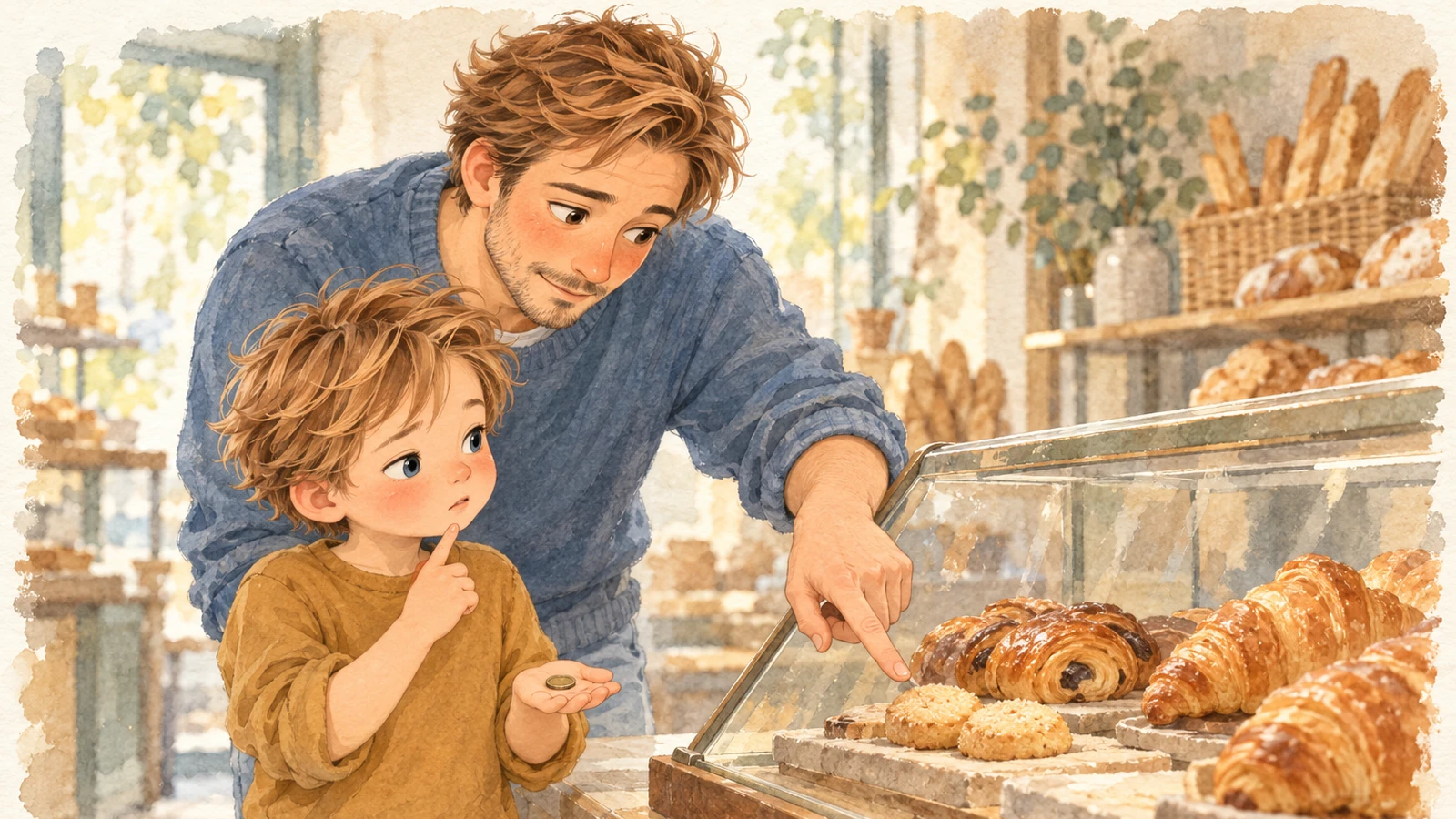
Oscar, my four-and-a-half-year-old son, had been holding his coin since we left home. At the bakery, he wanted to pay all by himself. I’d let him take one euro from his little purse to choose something.
In front of the display, he pointed to a large chocolate pastry.
“I'll pay with this.”
In his palm, the coin looked as though it could take care of everything. I’d given him money. I hadn’t yet explained what it could buy.
Having a coin isn’t knowing the price
I began by saying it wasn’t enough. Oscar looked at his hand, then at the pastry. The coin was still there. Why wasn’t it working?
For me, one euro came with a whole set of comparisons. For him, it was mostly the object adults handed over before receiving something. I couldn’t expect him to guess the difference between prices just because he understood the act of paying.
I could have quietly added the rest to keep his first purchase a lovely moment. But he’d then have paid “all by himself” with an amount that was mysteriously sufficient.
I could also add money and explain it. That day, we’d agreed he would choose with his coin. Above all, I needed to make that boundary visible before the till, not when someone was waiting behind him.
A choice small enough to understand
We stepped out of the queue. I asked which small biscuits cost one euro or less, then showed Oscar two options. He could choose either one, or keep his coin for another time.
He looked at the chocolate pastry again. I acknowledged that he wanted it. The limit didn’t make his wish ridiculous.
“With your coin, you can buy this biscuit or that one.”
“The chocolate one costs more. Today we're choosing with the money you brought.”
He didn’t need to learn subtraction on the pavement. We had a coin, a few options and a real decision to make. I stayed beside him for the exchange and to help him collect any change.
He chose a biscuit, handed over his coin and received his little bag. Outside, he asked whether he could buy the big pastry with two coins.
We weren’t finished with prices. But his question had changed: having a coin wasn’t enough any more. He was beginning to wonder how much.
Keep this handy
The situation
Your child wants to pay all by themselves with a coin.
Try this
Notice what your child is trying to do and leave room before offering another idea.
- “Would you like me to join in, or would you rather carry on?”
Keep in mind: Play does not need to be directed or turned into a learning activity every time.