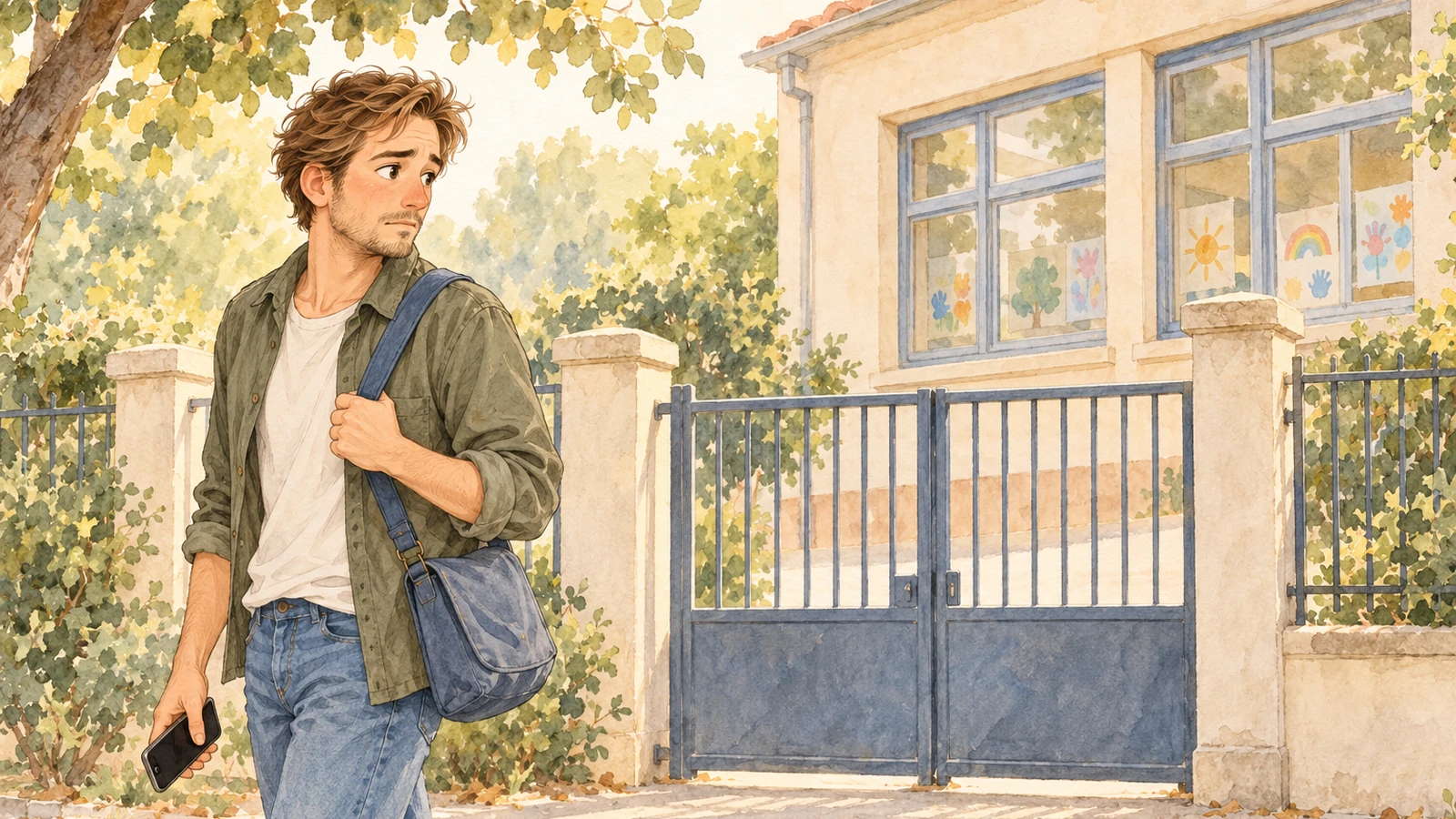
Oscar, my four-and-a-half-year-old son, had gone into his classroom without difficulty. He’d spotted a construction on a table and given me an almost distracted wave.
I was still outside the gate when I began wondering whether he’d be able to open his lunch box.
Then whether he’d dare ask for help. Then whether someone would notice he needed the toilet.
Oscar had gone into school. My worry was only just starting its day.
When the parent can no longer see what happens
I hadn’t observed anything alarming that morning. That was precisely the problem: I wouldn’t be observing anything for several hours.
At home, I see a hesitation, a glass too far away, a trapped sleeve. I can step in before Oscar even asks. At school, other adults take over and some difficulties get sorted without me.
I knew that. Yet my imagination was filling the empty spaces very diligently. It had already arranged a complicated lunch before I’d left the street.
I could ask myself what I actually knew: Oscar had gone in calmly. The staff knew the children. I’d shared what was useful. The rest of my little film wasn’t a report.
That didn’t prove everything would be perfect. It simply stopped me treating every possibility as an event that had already happened.
Plan a conversation, not invisible surveillance
If there had been a concrete difficulty, I could have discussed it with staff. A known need doesn’t disappear because a parent decides to worry less.
But that morning, I mostly wanted a certainty nobody could provide minute by minute. Sending one question about the box, then another about the toilet, might only have reassured me until the next thought.
I decided to ask how lunch was going at our next planned conversation. One specific question at a suitable moment, rather than a whole day trying to check remotely.
Then I put my phone away and headed back towards work. I didn’t need to feel perfectly calm to walk to the station.
At pickup, I asked Oscar what he felt like telling me. Not to certify that each of my scenarios had been avoided. He told me about a bridge they’d built together and a child who’d put a lion on it.
I thought about his box. I could still ask staff my question. He could keep a day that wasn’t reduced to my worries.
He’d left the gate behind long ago. It was my turn to get moving.
Keep this handy
The situation
Your child goes into school easily, but you keep imagining their day.
Try this
Listen to what your child shares and find one helpful cue for the next goodbye or reunion.
- “What was the easiest part, and what was the hardest?”
Keep in mind: A difficult goodbye or pickup does not tell the whole story of the day.