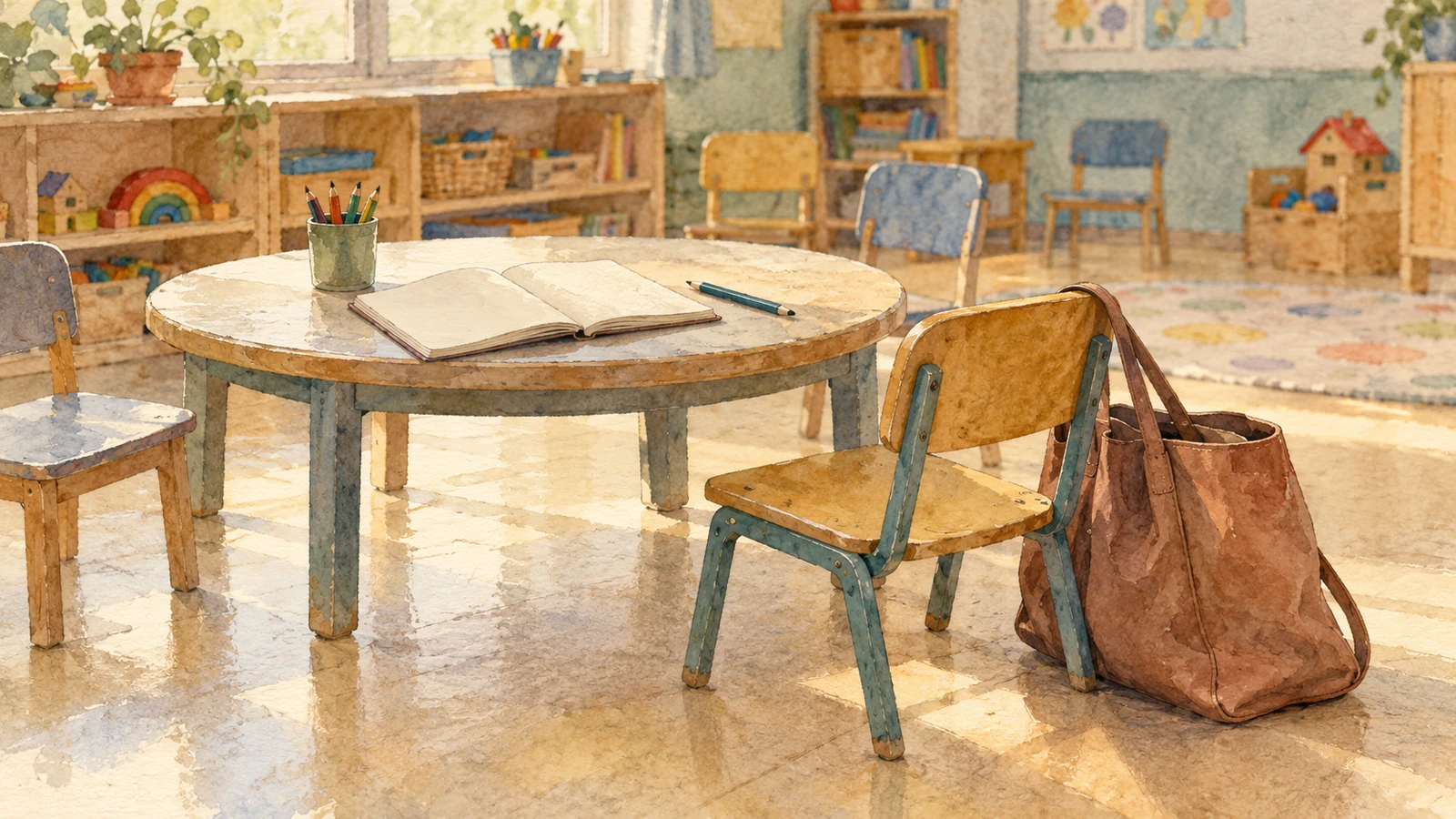
At the start-of-year meeting for Iris, my three-and-a-half-year-old daughter, I sat on a chair clearly designed for somebody else. My knees already knew it.
I’d come to understand her day. Within a few minutes, I was mostly trying to understand the other parents.
The woman beside me took out a folded sheet. I opened my notebook a little faster, as though we’d be handing in our notes at the end.
At a school meeting, adults look for their place too
The teacher explained where to put spare clothes. A father asked whether both socks needed a name. I thought the question very precise, then realised I couldn’t even remember whether I’d supplied socks.
I immediately wrote “check bag”. My neighbour turned her sheet over. Perhaps she’d prepared remarkable questions. Perhaps her shopping list was on the back. From my little chair, I’d already credited her with complete mastery of the school year.
When my pen stopped working, I searched my bag with a discretion that knocked over a water bottle. So much for my contribution to classroom calm.
The father with the socks handed me a pencil.
I’d just spent several minutes placing the adults around me. He’d simply noticed that I needed one.
Keep the information, drop the ranking
I could listen without deciding who was best organised, most worried or closest to the teacher. A persistent question might conceal a concern I knew nothing about. A silent parent hadn’t necessarily understood everything, or had nothing to say.
And my own notes proved only that I needed to write things down to remember them.
I circled the information that really concerned us: the things to leave at school, how outings worked and whom to contact with a question. The rest could wait.
If something concerned Iris alone, I could ask for a conversation another time. I didn’t have to present her whole life to the group, or leave with every possible answer to be an attentive enough mother.
At the end, my neighbour asked what the teacher had said while she’d been looking for her phone. I’d written down the answer. For once, my notebook served a purpose beyond making me look composed.
We compared two pieces of information, not our children. Then I returned the pencil and looked for my bottle under the table.
The next day, Iris asked whether I’d tried her chair. I said yes. At last we had a subject in which she clearly had more experience than me.
Keep this handy
The situation
Does the school meeting make you feel that every other parent already knows everything?
Try this
Listen to what your child shares and find one helpful cue for the next goodbye or reunion.
- “What was the easiest part, and what was the hardest?”
Keep in mind: A difficult goodbye or pickup does not tell the whole story of the day.