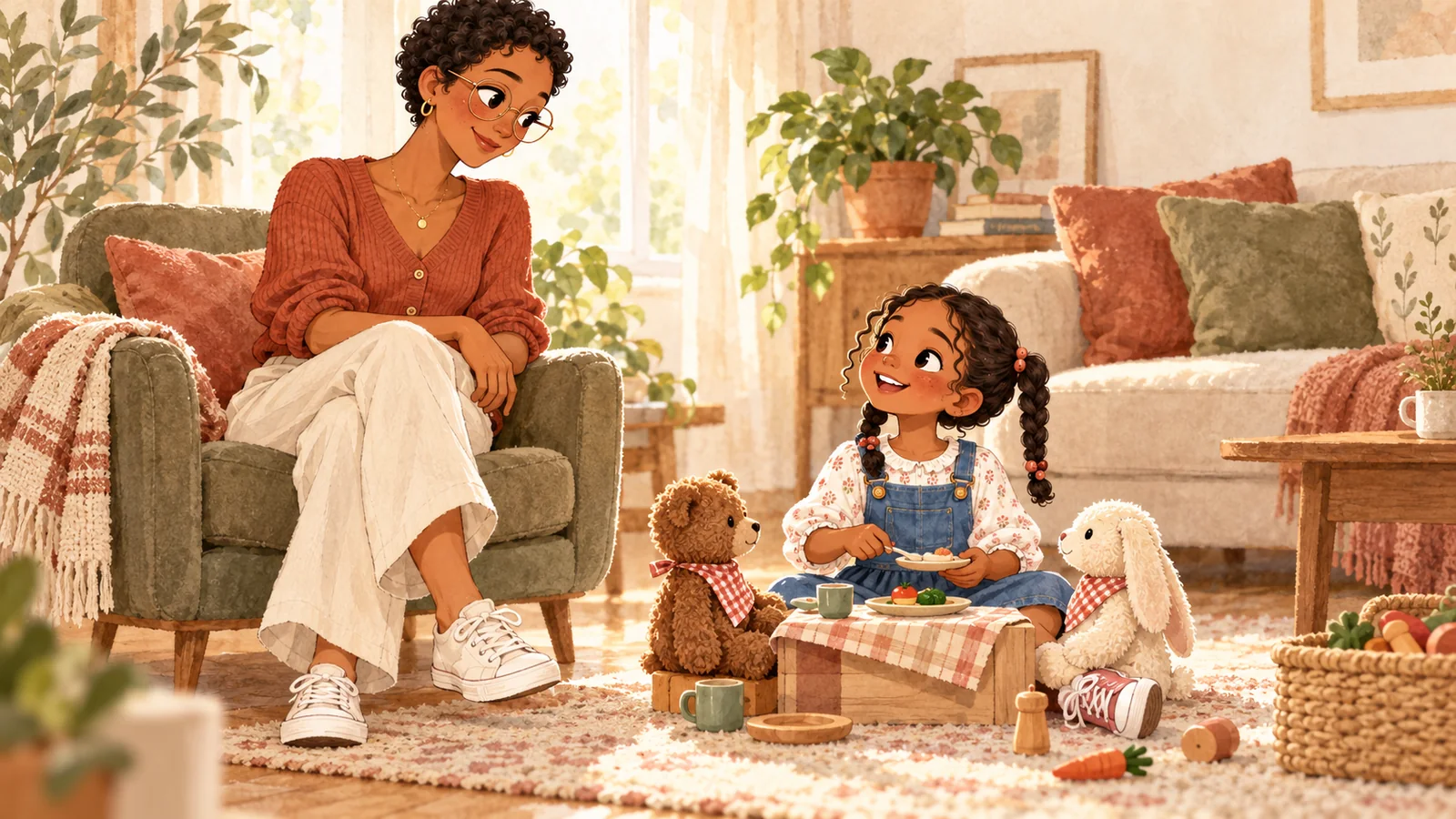
Louise, my five-year-old daughter, had just finished an episode of Bluey when she grabbed two stuffed animals and set them down in front of me.
“Shall we play restaurant?”
Dinner still needed clearing away, and I mostly wanted nobody to ask me to become a dog, a customer or a waitress for the next twenty minutes.
“Not right now, sweetheart.”
Louise looked at the screen, still on.
“But in Bluey, the parents play all the time.”
There it was. I had just been compared to a cartoon dog, and I had still managed to feel a little guilty.
Not wanting to play with your child is not a flaw that needs fixing. You can love watching them invent stories without having the energy to step into every scenario yourself.
When a kind show becomes an impossible standard
I like Bluey precisely because the adults often enter the children’s world. They play, improvise and turn an ordinary moment into an adventure. It’s funny and sometimes gives us good ideas.
The little bug begins when we stop seeing it as fiction and start treating it like a demonstration of what a “good parent” should manage all day.
I wasn’t consciously telling myself I had to be like the parents in Bluey. Still, as I looked at Louise’s stuffed animals, a small voice in my head said: five minutes of play isn’t much to ask.
Except sometimes five minutes is too much. And that doesn’t necessarily mean anything is wrong.
Saying no to a game without rejecting your child
“I don’t feel like playing” can sound harsh because it is easy to hear: “I don’t want to be with you.” They are not the same thing.
You can be available in other ways: listen to the story your child is making up, look at their construction, answer when they come to show you something, or simply stay in the same room without joining the game.
That evening, I could have said yes out of guilt and spent twenty minutes waiting for the restaurant to close. I chose to be clear instead.
“I don’t feel like playing restaurant right now. You can get started and show me what you’ve made afterwards.”
“I’ll stay near you, but I’m not going to play this time.”
Louise did not applaud this new family policy. She sighed, seated her stuffed animals at the table and started without me.
A few minutes later, she brought me an empty plate.
“It’s your cake. You don’t even have to play, just eat it.”
I ate the imaginary cake. She went back to serving her customers, very pleased with her compromise.
I hadn’t played restaurant. But I had still stepped a little way into her world, in my own way.