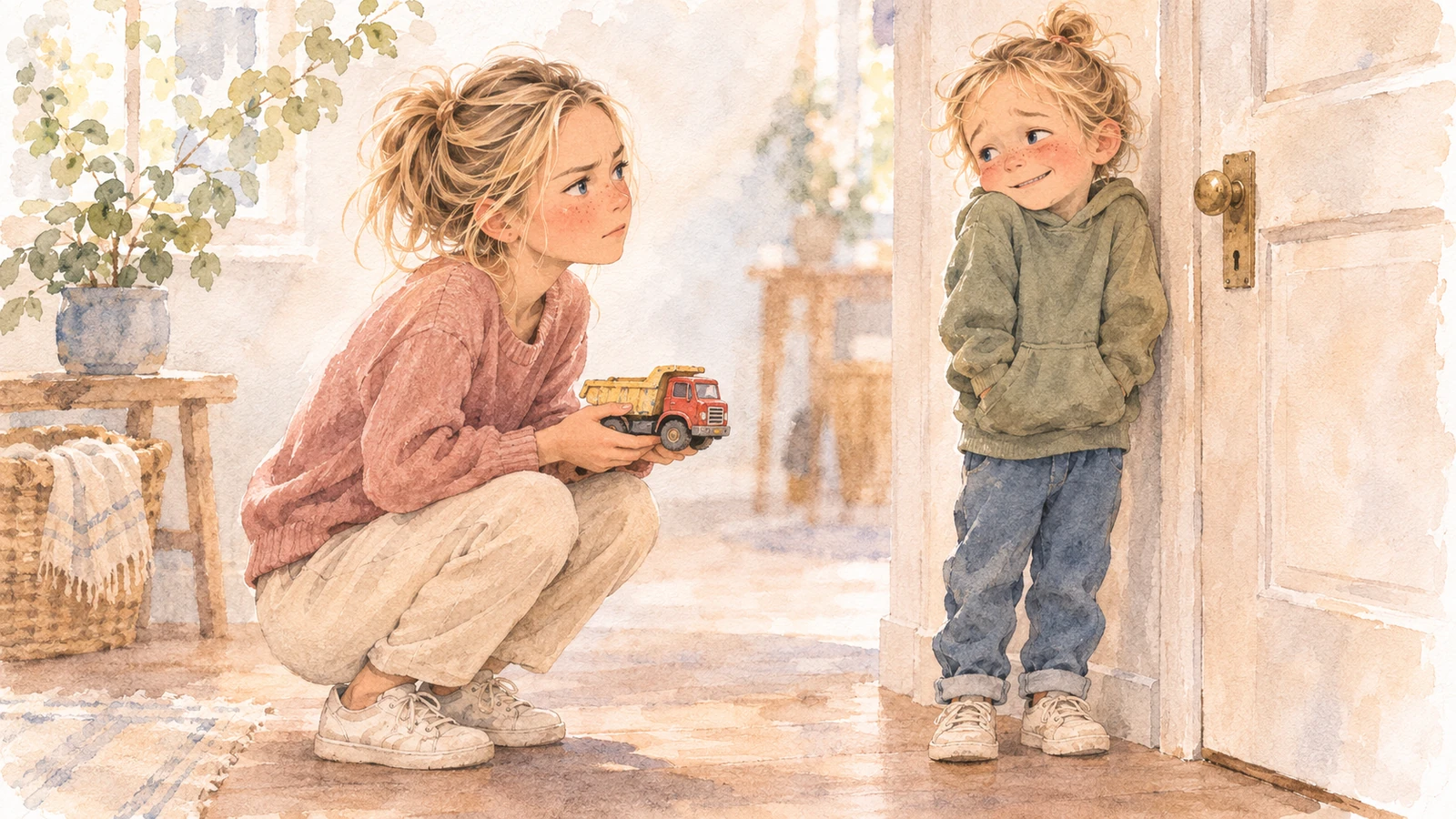
Gabriel, my almost four-year-old son, had just thrown a little truck against the door. I was explaining that I wouldn’t let him throw toys when he started laughing.
I felt my voice rising. The truck had already caused enough trouble, but to me that laugh had added a personal insult. I was about to ask what he found so funny.
Laughter during a telling-off doesn’t explain everything
A child who laughs when being told off isn’t necessarily mocking us. Stress, embarrassment or confusion can also produce a reaction that seems completely out of place to an adult.
I couldn’t read Gabriel’s thoughts. His laugh could mean several things, and I didn’t need to choose the right one immediately to stop the throwing.
The trap was elsewhere: by insisting that he stop laughing too, I was changing the subject of the scene. We had started with a thrown truck and were heading towards a discussion about the respect he owed me, with my irritation in charge.
I could be upset without asking his face to display the expected expression. Looking solemn wouldn’t have proved that he understood the rule either.
Return to the action that needs to stop
I picked up the truck and put it out of reach for the moment. My responsibility was to protect people and objects, then help Gabriel understand what he could do instead.
A short sentence was better than continuing the commentary while he laughed and I became angrier. I could also lower my volume before starting again.
“I won't let you throw the truck against the door. I'm putting it here.”
“When you're cross, you can tell me. The truck stays on the floor.”
I didn’t have to obtain an immediate apology for the boundary to exist. When we were more ready, we could look at the door, check the damage and repair what we could, without humiliating Gabriel.
If this mismatch happens often, I can observe the context: how I intervene, tiredness, what he seems to understand. Looking for an explanation doesn’t excuse every action. It avoids adding a hostile intention when I don’t know there is one.
Gabriel gave another little laugh, then asked whether the truck was broken. I looked at it with him. We were talking about the toy and what had happened again, instead of trying to win against his smile.
Keep this handy
The situation
Your child laughs during a telling-off and you experience it as mockery.
Try this
Lower your voice and return to the action that needs to stop, without requiring a facial expression to prove respect.
- “I'll speak more quietly. The rule stays the same.”
Keep in mind: Laughter can mean several things. Understanding the context doesn't remove safety or repair.