I had put three boxes in the middle of the bedroom: keep, give away, throw away. Oscar, my four-and-a-half-year-old son, was helping me sort the toys. Well, mostly he was moving the ones I had just put away.
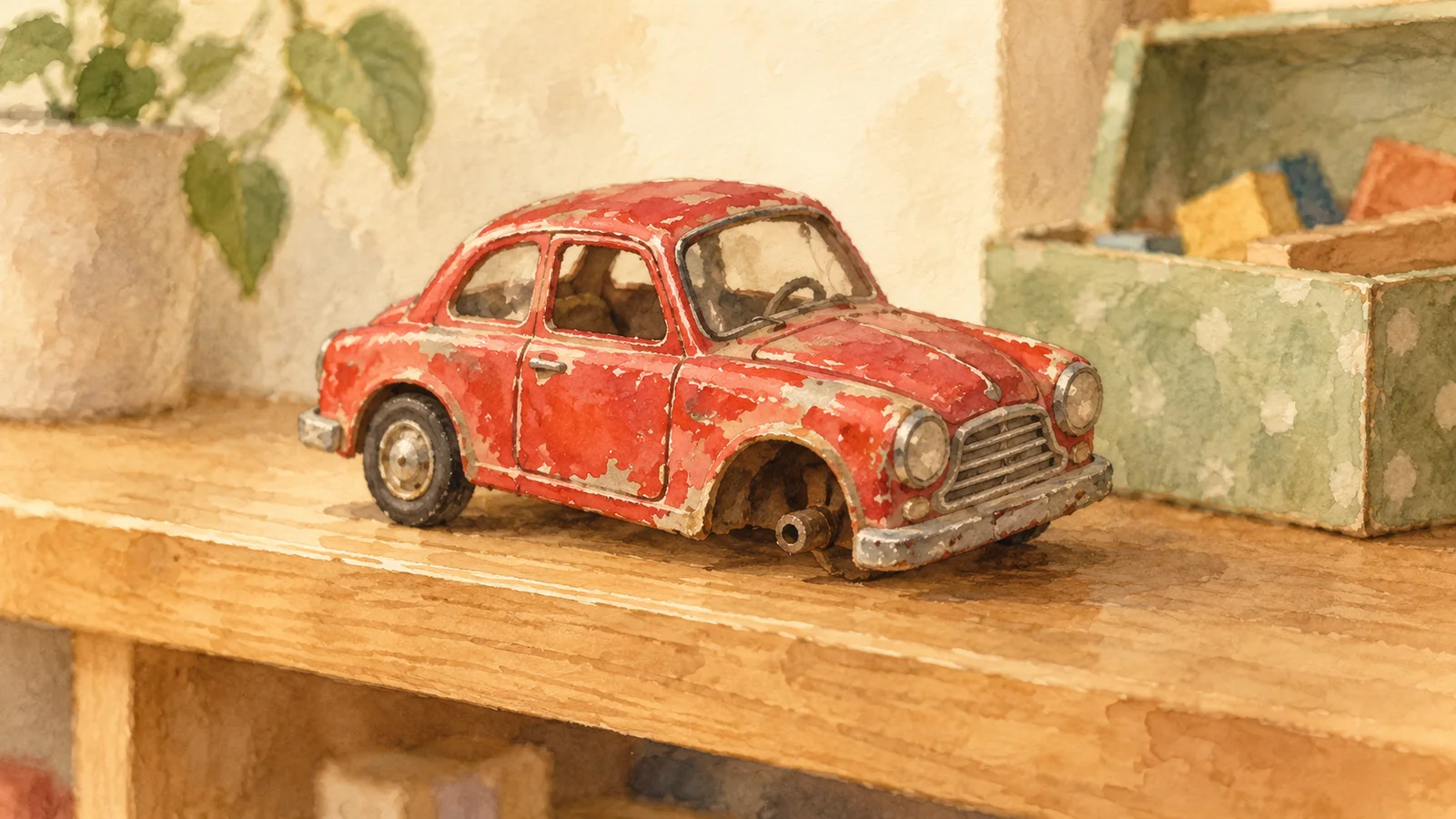
When I picked up his little red car, he took it back before I reached the third box. One wheel was missing, the paint was scuffed and it no longer rolled straight. My child refused to throw away a broken toy. I thought he simply refused to make room.
A broken toy is not necessarily a worthless toy
I asked why he wanted to keep that one. Not the twenty other cars, that one.
Oscar showed me the roof, where he put a tiny figure. This was the car that took the figure on holiday. It had already crossed the hallway, the sofa and a mountain of cushions. Since losing its wheel, it had been sitting broken down in his garage.
I had seen an unusable vehicle. He still had a story in progress.
I put the car down. Not because I had discovered that we needed to keep everything, but because my sorting rule said very little about what Oscar did with his toys. I was looking for the ones that still worked; he was keeping the ones that had a part to play.
Making room without putting everything in the same box
The space problem had not disappeared. The cars still overflowed their tub and I did not want to turn the bedroom into a museum of damaged objects.
I suggested that Oscar choose a few vehicles to keep on the shelf, including those that no longer rolled. We went back to sorting the others together. He gave away an almost new car he did not particularly like. The one with three wheels stayed.
We can start by asking what the child still wants to do with the object, rather than immediately explaining why it is no longer useful. Then name the real limit: the available space, a dangerous part or something that cannot be repaired. Acknowledging a child’s attachment does not mean leaving a dangerous toy within reach.
“Can you show me what matters to you about this car?”
“We’re keeping the ones that fit on this shelf. Which ones would you like to choose?”
Sometimes a child has no explanation to give. We can set a safe object aside and return to the decision later, without using the opportunity to make it quietly disappear.
The red car did not get its wheel back. It got its place in the garage back.