Malo, my almost three-year-old son, had asked to play in his room. I heard a few little sounds, then nothing. A spell of quiet that seemed very convenient.
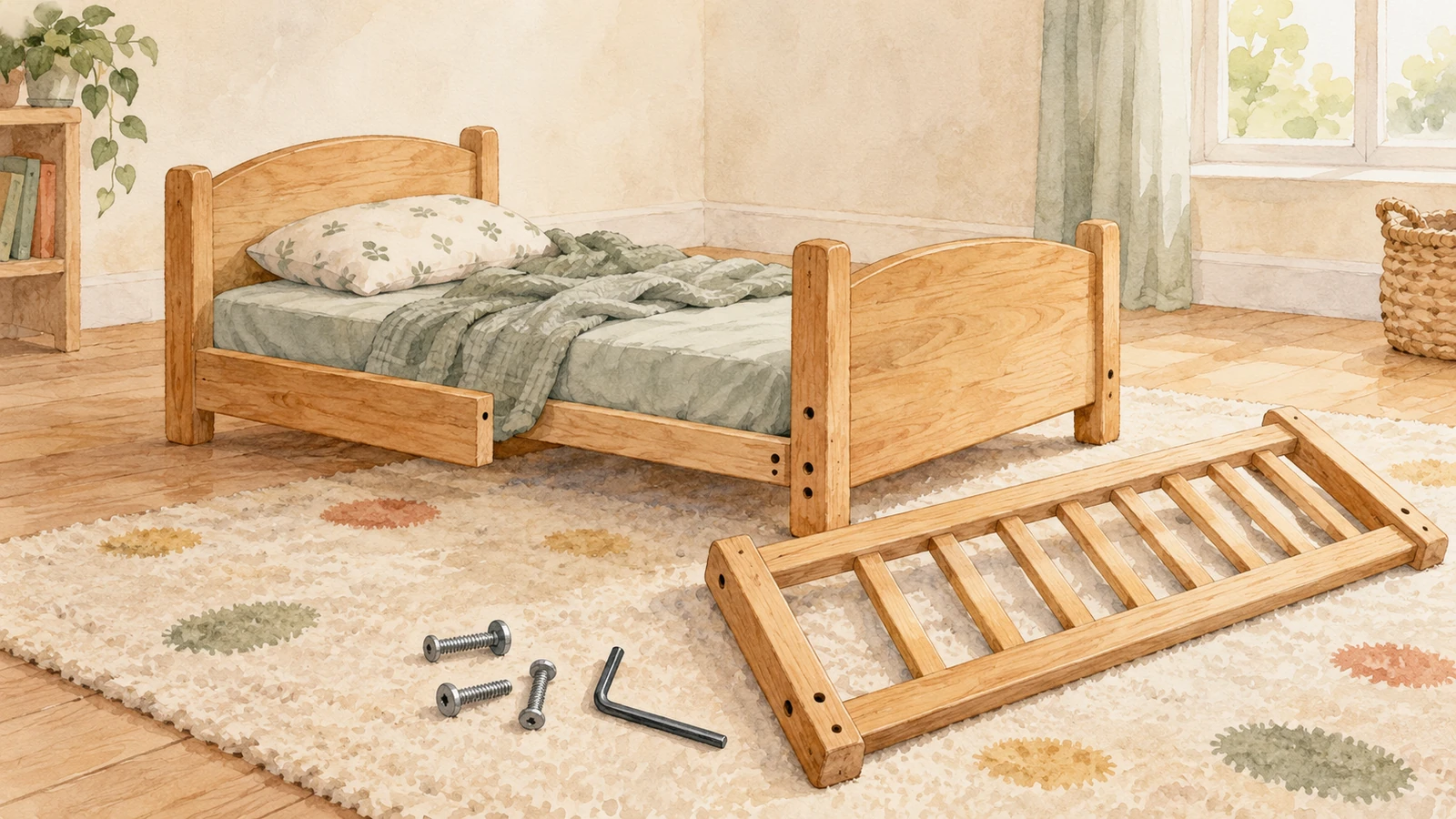
When I went in, he was crouching by his bed with an Allen key in his hand. Several bolts were on the floor and one side of the bed was no longer secure. He was still turning the key with remarkable concentration.
My child was taking his bed apart. I was already thinking about reassembling it, bedtime and the awkward question: where had he found that tool?
First, stop the dismantling
I moved him away from the furniture, then put the key and small parts out of reach. The bed stayed inaccessible and was not used until it had been reassembled and checked against its instructions, with no missing parts or loose fittings.
A loose joint is not a small detail to watch out of the corner of your eye while a child carries on experimenting. Safety came before any discussion of his intentions. And the tools needed a genuinely inaccessible home, not just a slightly higher drawer.
Once Malo was away from the bed, I could look at his actions differently. He had not hit the wood or thrown the pieces. He had found something that turned, then discovered that turning it long enough separated two parts.
Understanding does not mean allowing
That did not make him a little engineering genius. Nor did it make the same action acceptable on any piece of furniture. But “he breaks everything” was a poor description of what I had just seen.
Malo was investigating how it stayed together. I needed to show him where he could investigate, with what and with whom nearby.
Explaining the price of the bed would not teach him where to try his next experiment. And giving him an appliance to dismantle would have added other risks to the bolts I had just collected.
Later, we got out a construction toy with large screw-together pieces, suitable for his age. I stayed beside him, with just a few pieces and a simple limit:
“The bed needs to stay sturdy. I won’t let you take it apart.”
“Here, you can screw and unscrew things with me. The grown-ups’ tools stay put away.”
Another day, he could watch me use a real tool for a repair without being given the small parts. The point was to make exploring possible without turning our furniture into test equipment.
Malo unscrewed the same big piece several times. Meanwhile, I found the bed’s instructions. We both had something to put back together, but no longer in the same place.
Keep this handy
The situation
Your child has started taking furniture apart with an accessible tool.
Try this
Move the child away, remove tools and small parts and prevent use of the furniture until it has been reassembled and checked. Later, offer an age-appropriate activity with an adult alongside.
- “I’m putting these parts away and taking you away from the furniture.”
- “I’ll show you where you can try turning and joining things.”
Keep in mind: Curiosity does not remove the danger. Incomplete furniture or loose fittings make it unsafe to use; an old appliance is not automatically a safe play material.