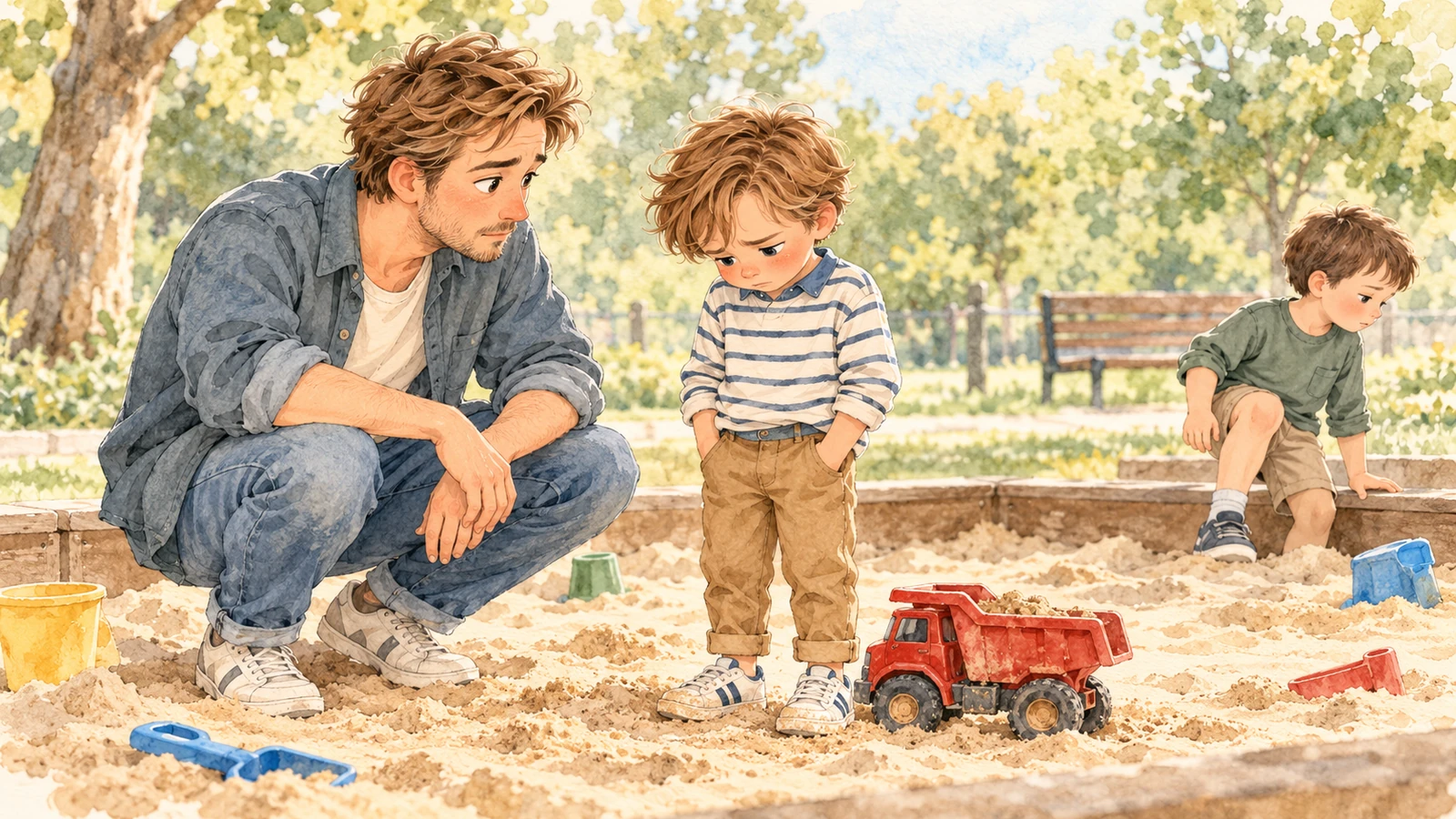
At the park, Oscar, Julien’s four-and-a-half-year-old son, was playing with a red truck. When another boy tried to take it, Oscar pushed him. Not very hard, but hard enough for him to land on his bottom.
Julien, his dad, went over to the two children. He checked that the boy was all right, then turned to Oscar.
Oscar stared at his shoes. Julien repeated it, a little more firmly. Nothing. The silence was becoming almost more embarrassing than the push.
The action obviously had to be stopped. But did the word “sorry” also have to arrive immediately?
When a child refuses to say sorry
Julien realised he had mixed together two goals. The first was to protect the other child and remind Oscar that pushing wasn’t allowed. The second was to show the adults around him that he took the situation seriously.
Oscar was still red with anger. He had just lost his truck, seen his friend fall, and now everyone was looking at him. In that state, saying the expected words wouldn’t necessarily mean he understood what he had done.
So Julien dropped the demand for an apology, but kept the boundary.
He took care of the boy, then suggested putting the truck aside for a few moments. Oscar protested, but didn’t push again.
Making amends doesn’t always start with a word
A little later, when both children were calm again, Julien asked Oscar what he could do so his friend could play again. Oscar thought about it, then brought him the truck.
He still hadn’t said sorry. His friend accepted the toy and they started building a road in the sand again.
That wasn’t proof that Oscar had understood everything. Nor was it a reason to act as though the push hadn’t happened.
Next time, Julien could again name the action, protect the child who was hurt and invite Oscar to make amends: return the object, ask whether the other child was all right or suggest restarting the game differently. If the word “sorry” came, so much the better. If it didn’t, that needn’t cancel out the repair.
On the way home, Julien thought back to waiting for a word in front of the whole park. He wanted to teach his son to care for other people. Perhaps, that day, he mostly needed to show him how.
Keep this handy
The situation
Your child has hurt someone but refuses to say sorry.
Try this
Check on the hurt child first, name what happened, then invite a concrete act of repair even if the word ‘sorry’ never comes.
- “Let's see how your friend is doing first.”
- “What could we do to help your friend get back to playing?”
Keep in mind: Forced apologies cannot replace concern for the other person or genuine efforts to make amends.