Iris, my three-and-a-half-year-old daughter, asked me why the flower had disappeared. On screen, things had already moved on to a song, then a train. I told her I hadn’t seen the flower. I was mostly watching the time: four minutes until the episode ended.
When choosing a cartoon suitable for a young child, I had taken a rather convenient shortcut: find the shortest one. The thumbnail showed smiling animals. That had seemed enough to start the video while I cleared away the snack.
Iris was still waiting to find out what had happened to that flower.
Choose a cartoon, not just a running time
The next day, I watched the beginning of the same episode. I finally saw the flower: a character was planting it, but the scene changed before we could understand what they were going to do with it.
I hadn’t discovered a dangerous programme. I had discovered that I knew almost nothing about what I’d chosen. The counter told me when it would end, not what Iris would have time to follow.
A pretty thumbnail and gentle music could make me feel reassured without telling me how the episode unfolded. In the same way, a video described as “educational” didn’t yet tell me what my daughter would be able to understand.
I had no desire to write an evaluation before every snack. But watching a few minutes seemed more useful than comparing three almost identical running times.
Notice what actually interests your child
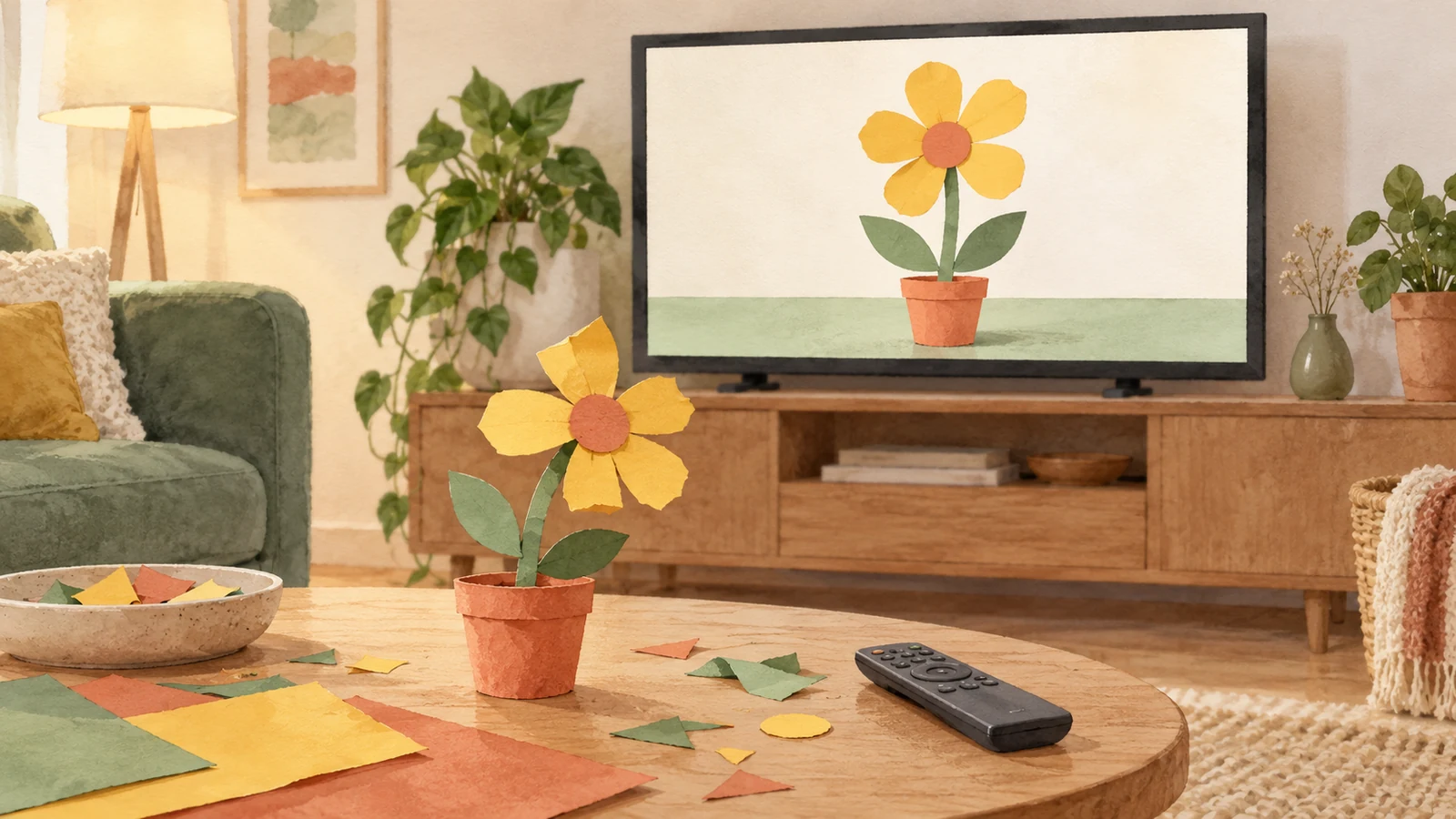
Another time, we put on a little story in which someone made a paper flower, then placed it in a pot. The actions stayed on screen long enough for Iris to ask to see the folding again.
That didn’t mean she cheerfully accepted me switching it off. Something she enjoys watching is still a screen she’d like to keep on. Choosing the programme didn’t replace our limit.
Afterwards, she asked for paper. We made a flower much less neat than the one in the video, with a stem that refused to stand upright.
Since then, I try to notice what she follows, what leaves her puzzled or what she brings into her play. Without asking her to retell the story or prove she has learnt something: snack time doesn’t need a quiz.
Some days, I simply put on an episode we already know. I keep our stopping point and prevent the next video from starting automatically. That’s enough for that day.
This time, when Iris mentioned the flower, I knew which one.