Oscar, my four-and-a-half-year-old son, was looking at the dark corner of his bedroom. I had already explained that the jumper on the chair was a jumper, that shadows came from the lamp and that nothing changed when we turned it off.
He had understood my explanations. He was still afraid of the dark.
Then he asked whether we could invent someone to help him cross the room.
I was about to start again with light and shadows. He was suggesting another language.
When explaining darkness isn’t enough
I didn’t want to tell him an invisible guard would chase away real monsters. But I could join a story he knew we were making up.
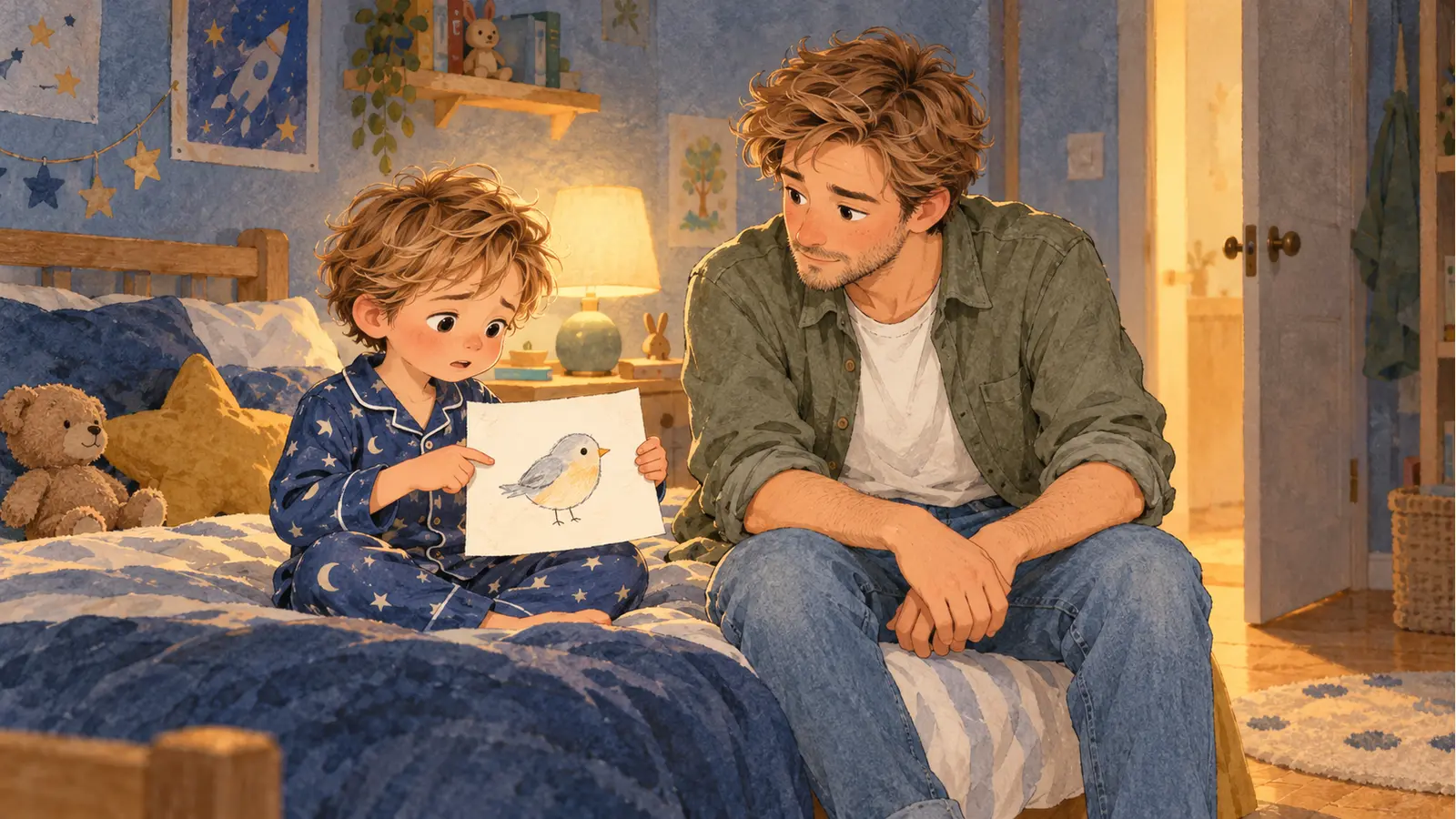
Oscar chose a small round bird that could walk in the dark because it knew the way to the door. Mostly, he wanted someone to walk beside him.
We drew it on a sheet of paper. I asked where he wanted to put the drawing. Oscar placed it near the lamp.
That drawing didn’t prove his fear had gone. It simply let him offer something instead of receiving another explanation about what he shouldn’t be afraid of.
Playing along without leaving him alone with the fear
I could keep some very real supports: a small light, the door ajar and my presence while we looked for what might help that evening.
The character didn’t have to become a requirement. If Oscar no longer wanted the story tomorrow, nothing would have gone wrong. And I didn’t want to say the bird would be disappointed if he called for me again.
“We can imagine it walking with you. We know it’s a story, and I’m still here to help you.”
“Would you rather leave the drawing by the lamp or take it to the door?”
Oscar took the paper. We walked a few steps together, then he asked me to turn the light up a little. I did. The game wasn’t a contract requiring him to stop being afraid.
If the fear takes up a lot of space, persists or regularly disrupts his nights, I can discuss it with a professional. An invented character doesn’t have to solve everything.
At bedtime, Oscar propped his bird against the lamp. He asked me to stay a while again.
I stayed beside him for a few more minutes. His little bird helped him see the dark differently, and I was still there when he needed reassurance.
Keep this handy
The situation
Is your child afraid of the dark even after your explanations?
Try this
It simply let him offer something instead of receiving another explanation about what he shouldn’t be afraid of.
- “That frightened you. Do you want to tell me what you imagined?”
Keep in mind: A child's fear can be real even when the imagined danger is not.