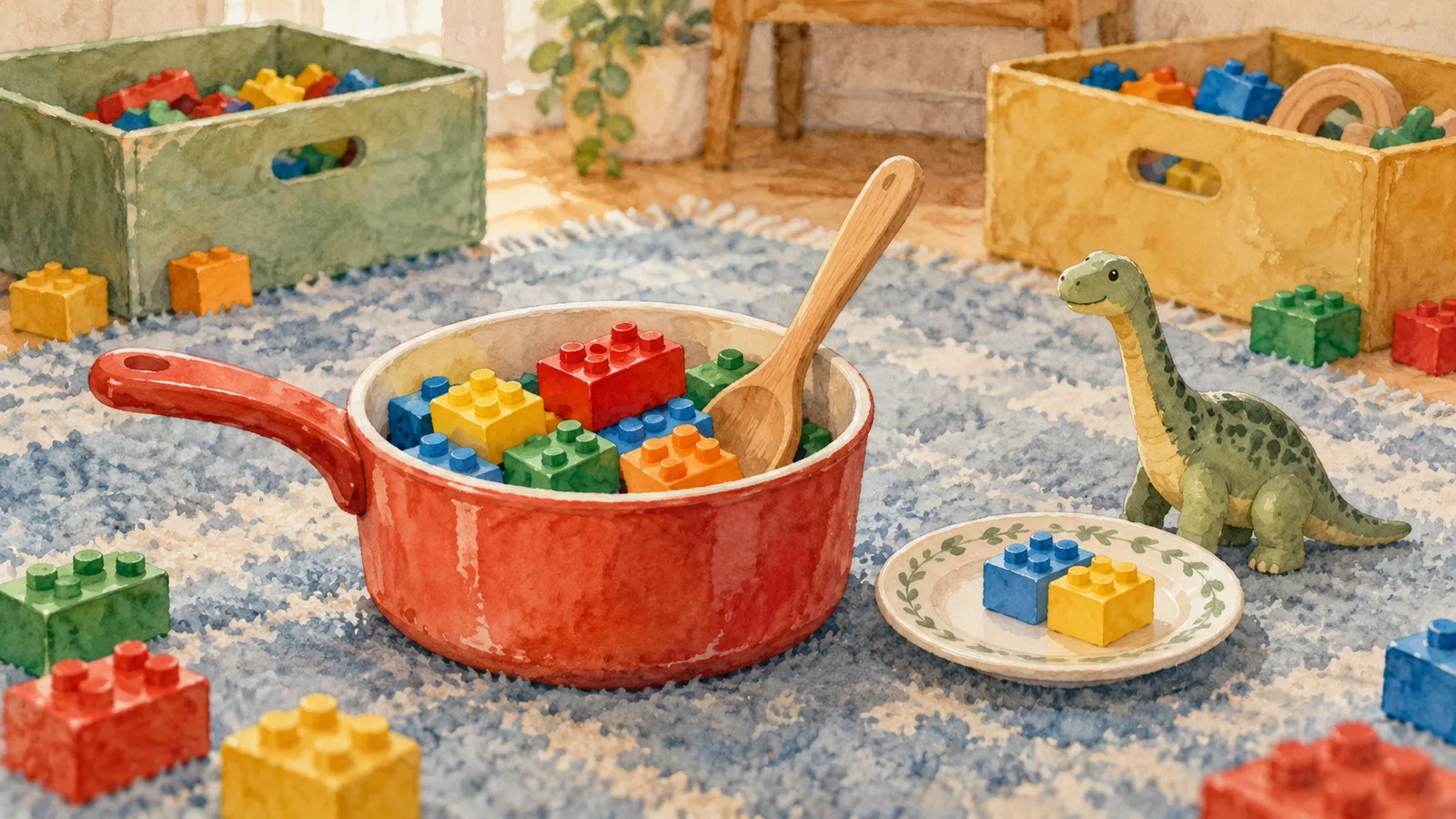
Malo, my almost three-year-old son, had emptied the chunky bricks into his toy saucepan. A dinosaur was waiting in front of a plate and two cars were parked by the pretend cooker.
The day before, I had sorted the toys into boxes. Building toys on one side, the kitchen set on the other and figures in a basket. A perfectly understandable system. At least to me.
I was about to ask him to put the bricks back when he announced, “The soup isn’t cooked yet.”
I saw mixed-up toys. He saw lunch in preparation, with some rather unusual customers.
Mixing toys can also extend the game
In my system, every object belonged to a category. In Malo’s game, every object could have a role. The green brick was a vegetable, so was the red one and the dinosaur had apparently booked a table.
He hadn’t necessarily forgotten where the building toys belonged. He was using them to make something that the kitchen accessories couldn’t quite provide in the way he wanted.
That doesn’t make every mixture fascinating. Sometimes a child simply empties a box, then moves on. But before interrupting the game, I could watch what he was organising or ask what was cooking.
Malo stirred his soup with a wooden spoon. He handed me a plate containing a single yellow brick. Apparently, I had ordered the tasting menu.
Sorting helped me find the toys. It didn’t need to determine every way they could be used.
A place to play and a time to tidy
My problem wasn’t just how it looked. Bricks in the walkway soon became a problem for my feet. And I didn’t want to spend the evening retrieving figures from under the furniture.
So I could keep a practical boundary: the kitchen and its ingredients stayed on the rug, without blocking the way. Once the game was finished, we would put the objects back in their boxes.
“You can use the bricks for your soup. We’ll keep the walkway clear.”
“When the restaurant closes, we’ll put the bricks back in their box together.”
That also leaves room to keep a setup until the next day, if there is space. What matters is knowing what we’re keeping and when we’ll deal with it, instead of putting everything away while the child is still playing.
That day, I moved two cars out of the walkway and accepted my plate.
The bricks would return to their box after lunch. For now, they were vegetables.