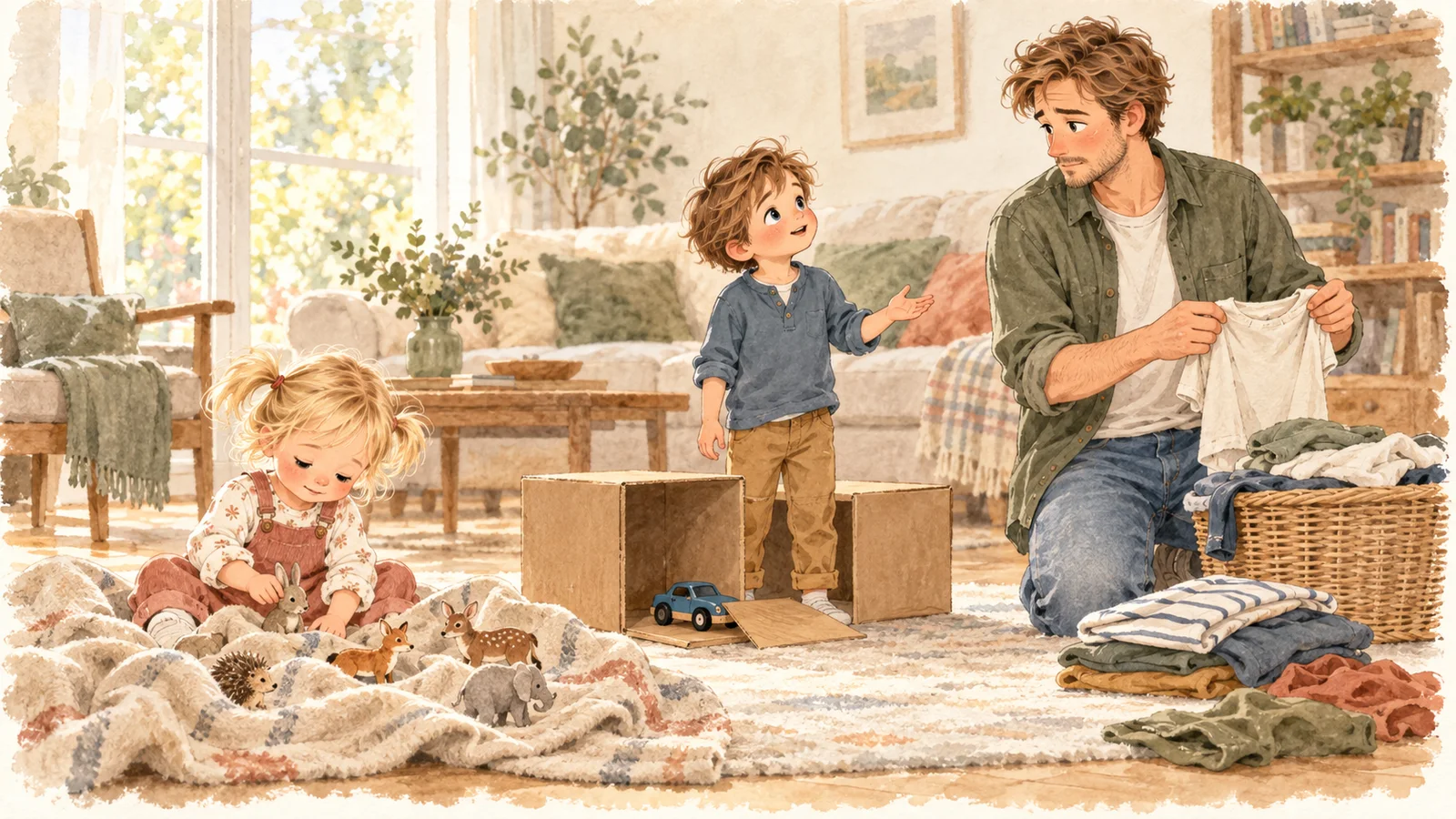
Alice, my two-year-old daughter, had been arranging animals in the folds of a blanket for twenty minutes. Oscar, her four-and-a-half-year-old brother, had just asked me three times what we were going to do.
I had brought out his cars, suggested bricks and pointed to the dressing-up box. He had looked at each suggestion, then asked whether I would play with him.
“Look, your sister can manage it,” I began.
That sentence was mainly going to teach him that Alice was doing something better than he was. It wasn’t giving him an idea for starting to play alone.
Two children, two ways of getting into a game
Alice could decide that a fold in the blanket was a house, then move her animals around for a long time. Oscar enjoyed playing too, but he often looked for someone to launch the story, comment on his building or answer him.
That contrast didn’t tell the whole story of their independence. Oscar did things on his own that Alice still asked me to do. And he could become absorbed in a game with a friend, while asking for me a lot when we were alone at home.
Age matters, but it doesn’t tell us exactly how long a child will occupy themselves without us. The chosen game, a wish for company or tiredness can also change the scene.
So I didn’t need to find out which of my children was “the most independent”. I needed to understand what helped Oscar enter that particular moment.
Helping them begin without playing the whole game
I sat beside him to make a garage from two boxes. We chose the entrance and the place for the tow truck. Then I told him I was going to fold the laundry, right beside him.
I could join in at the start without becoming essential to every parked car. And I could set a limit on my availability without using Alice as the demonstration.
“We’ll start the garage together. Then you can carry on while I fold the laundry.”
“I’m right here. You can show me how it’s going when I’ve finished this pile.”
That doesn’t mean preparing an activity every time a child asks. Sometimes I can simply stay nearby and leave them a little time to think. Helping them get started is an option to try, not a guarantee of twenty minutes of silence.
Oscar called me again about a stuck wheel. I helped him, then went back to the laundry. Beside us, Alice had abandoned her animals and wanted to join me.
The roles had already changed.
That day, the garage let me fold a few tee-shirts. I didn’t time which of my children had left me alone for longer.