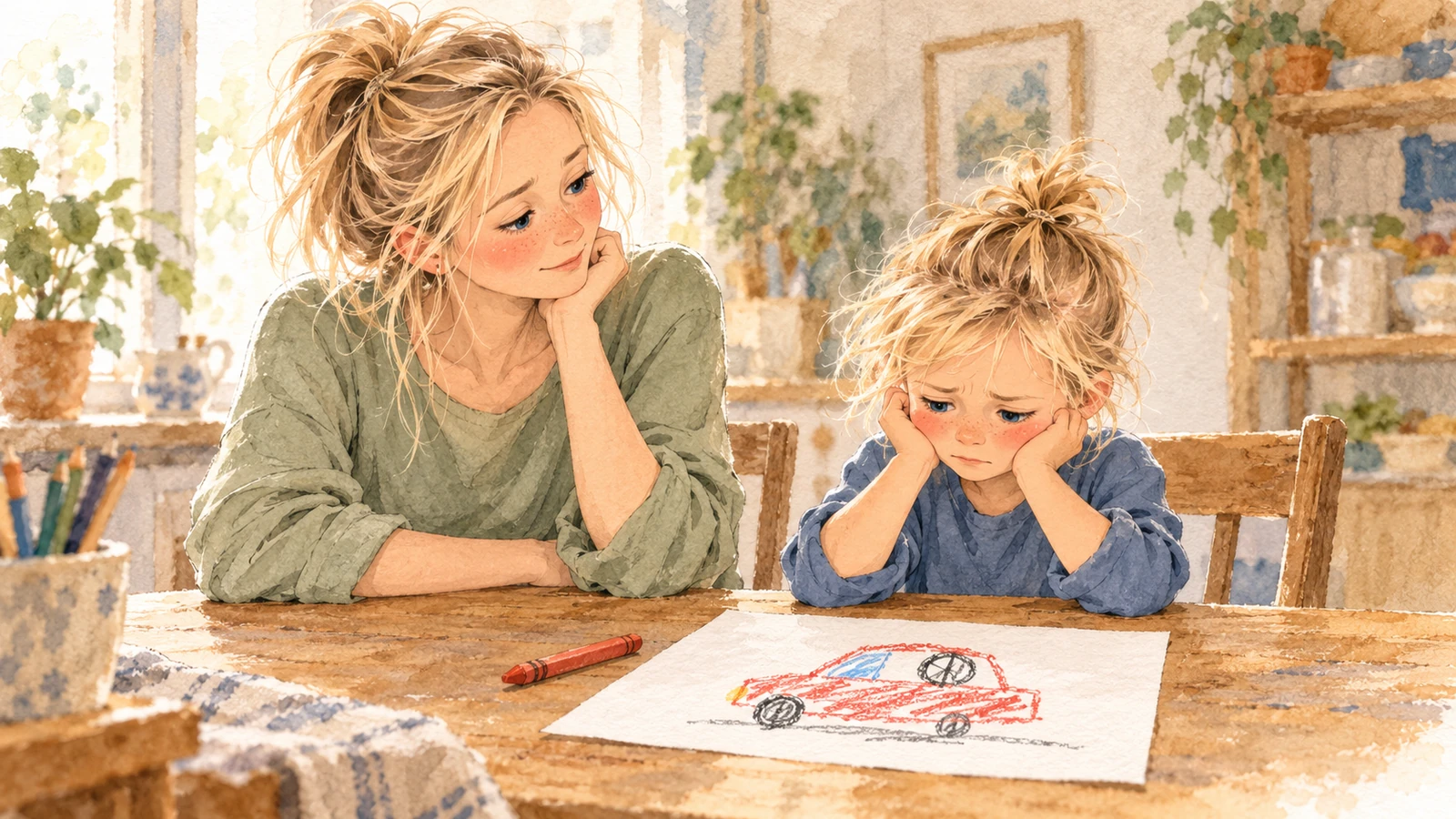
Gabriel, my almost-four-year-old son, was drawing a car. He’d planned big wheels and a boot large enough for a dinosaur. On the page, one wheel had ended up in the window.
He pushed his crayon away.
“I'm rubbish.”
I was about to say, “No, you’re not, it’s beautiful!” The answer was ready. When my child says he’s rubbish, I want to remove the sentence as quickly as a dangerous object.
But his drawing would still be there in front of us.
“I’m rubbish” can begin with one specific difficulty
I didn’t want to agree with his judgement. A misplaced wheel said nothing about his worth. Nor did I know whether that sentence went beyond this moment’s disappointment.
I asked what he’d wanted to draw differently. Gabriel pointed to the wheel: it was supposed to be under the car, not in the window.
My compliment would have been about beauty. He was talking about a wheel. We could have argued for ages without ever looking at the same problem.
“You wanted the wheel underneath, and it ended up here. That's annoying you.”
He nodded. I added that this drawing didn’t make him rubbish. We could work out what to do with that wheel, or leave the sheet for now.
I didn’t need to convince him to like his drawing in order not to leave him alone with his disappointment.
Help without taking over the crayon
Gabriel could start again on another sheet, keep this car or ask for specific help. I offered those possibilities without deciding the session had to end in success.
He chose a new sheet. Then he asked me to draw the car.
I could have produced a neater model. But he also wanted to do it himself. I asked which part he wanted us to work out together. We looked at where to put the wheels before drawing the rest.
That didn’t guarantee a drawing matching his plan. It simply made the next attempt a little more concrete.
If those words keep returning, I can revisit the conversation at a quiet moment and notice which situations bring them out. One sentence over a crayon isn’t enough to tell the whole story of a child’s confidence.
On the new sheet, Gabriel drew two enormous wheels. The dinosaur still had no boot, but it could travel on the roof.
I said I could see where he’d put his wheels. He looked at his drawing, then added a ladder for the dinosaur. This time, we’d found a way to carry on.