Sometimes we can see that something is wrong. Our child is upset, tense or close to tears, but the moment we ask what is happening, they shut down.
They say “nothing”, look away or become even more upset. That silence does not necessarily mean they refuse to talk to us. They may simply not know how to express their emotions or turn what they feel into words.
Not being ready to talk does not mean the feeling should be ignored.
When a child cannot express their emotions
When our child is struggling, we naturally want to understand. So we ask, “What’s wrong?”, “Why are you crying?” or “What happened?”
But in the middle of a big feeling, answering can feel impossible. A child has to work out what is happening inside, find the words and deal with our expectation at the same time. Even a gentle question can feel like extra pressure.
Instead of insisting, we can offer another route.
Putting the feeling outside the body
Writing slows things down. A thought that was spinning around inside the head becomes something we can look at together.
We might write:
- “You really wanted that toy. Let’s put it on your wish list.”
- “That was a hard day. Let’s make a little list of everything that went wrong.”
- “You have lots of things in your head. I can write them down while you tell me.”
The problem is not necessarily solved. But it has become visible, more concrete and often a little less overwhelming.
They do not need to know how to write
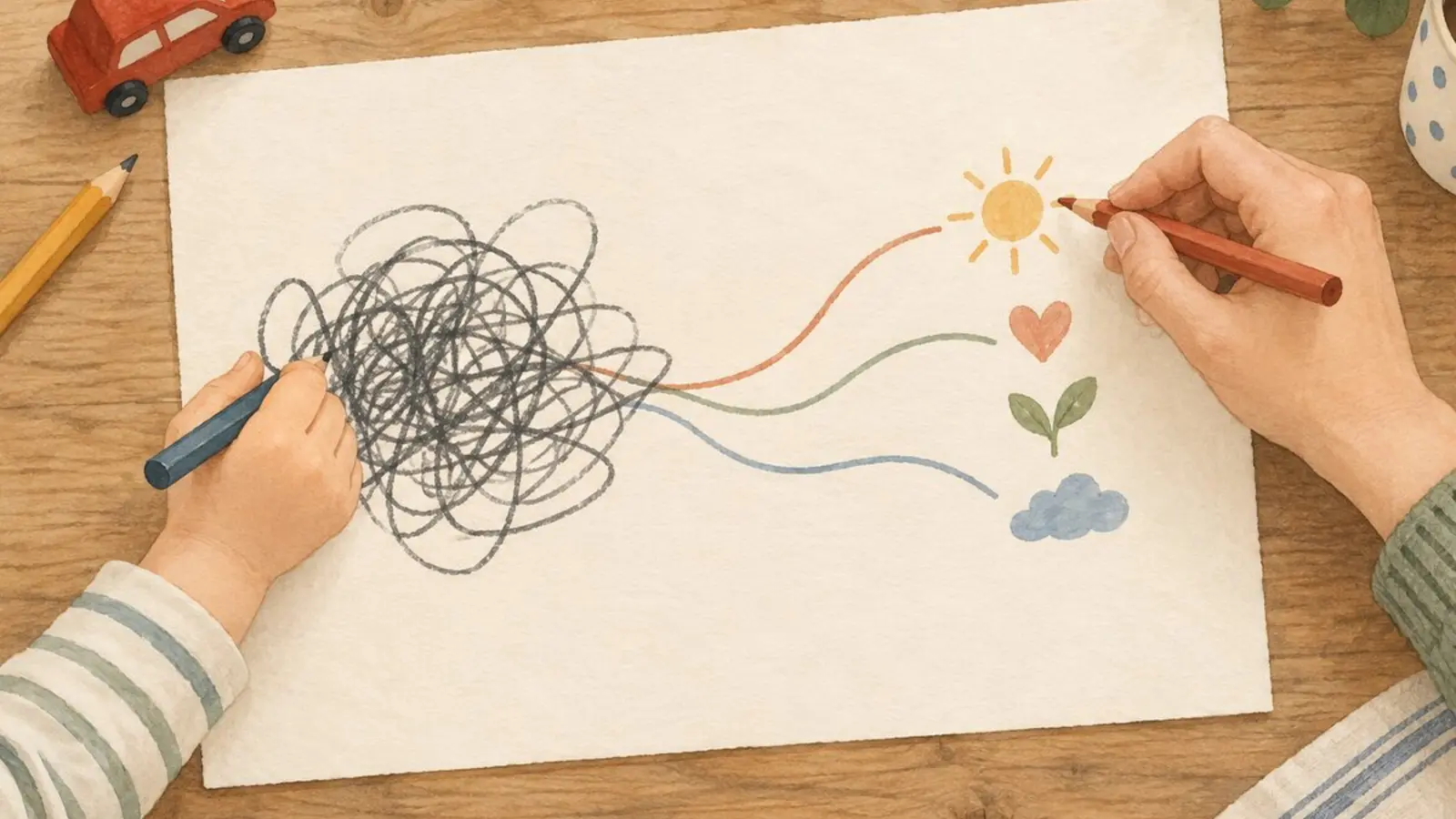
This works with very young children too. The parent can hold the pen and write the child’s exact words without correcting or rephrasing them. The child can draw, choose a colour or simply watch the list grow.
The form does not matter. The message does:
“There is room here for what you are feeling.”
It comes from the same idea as acknowledging the feeling before trying to correct it: a child does not need the feeling to disappear before we can support them.
A wish list can make room for a want without promising to fulfil it. A drawing can make room for anger without allowing hitting. A few words on paper can acknowledge disappointment without needing to remove it.
When the main issue is setting a boundary, offering a concrete alternative instead of a simple “no” can also help a child understand what they can do instead.
Making space to talk later
Writing does not replace conversation. It creates space for it to happen when the child is ready.
Some children will want to read the note again a few minutes later. Others will come back to it that evening or the next day. Some may never talk about it again, but still feel that their experience was taken seriously.
“I can write it down for you.”
“Let’s put it on the list so we don’t forget.”
“You can show me with a drawing.”
Not everything needs to be understood and fixed in the moment. Sometimes a feeling simply needs somewhere to land before it can be told.