Nora had set out freshly sharpened coloured pencils for Iris, her three-and-a-half-year-old daughter. She had chosen chunky ones that were easy to hold and added a large sheet of paper. Everything seemed ready for drawing.
Iris made a few lines, looked at the result, then asked for the felt-tip pens.
Nora thought: already? When looking for drawing tools for her child, she had tried to make a considered choice. Felt-tips seemed like the easy option, the one that produced lovely colours without much effort.
Iris mostly wanted her red to show up.
The right tool for which kind of mark?
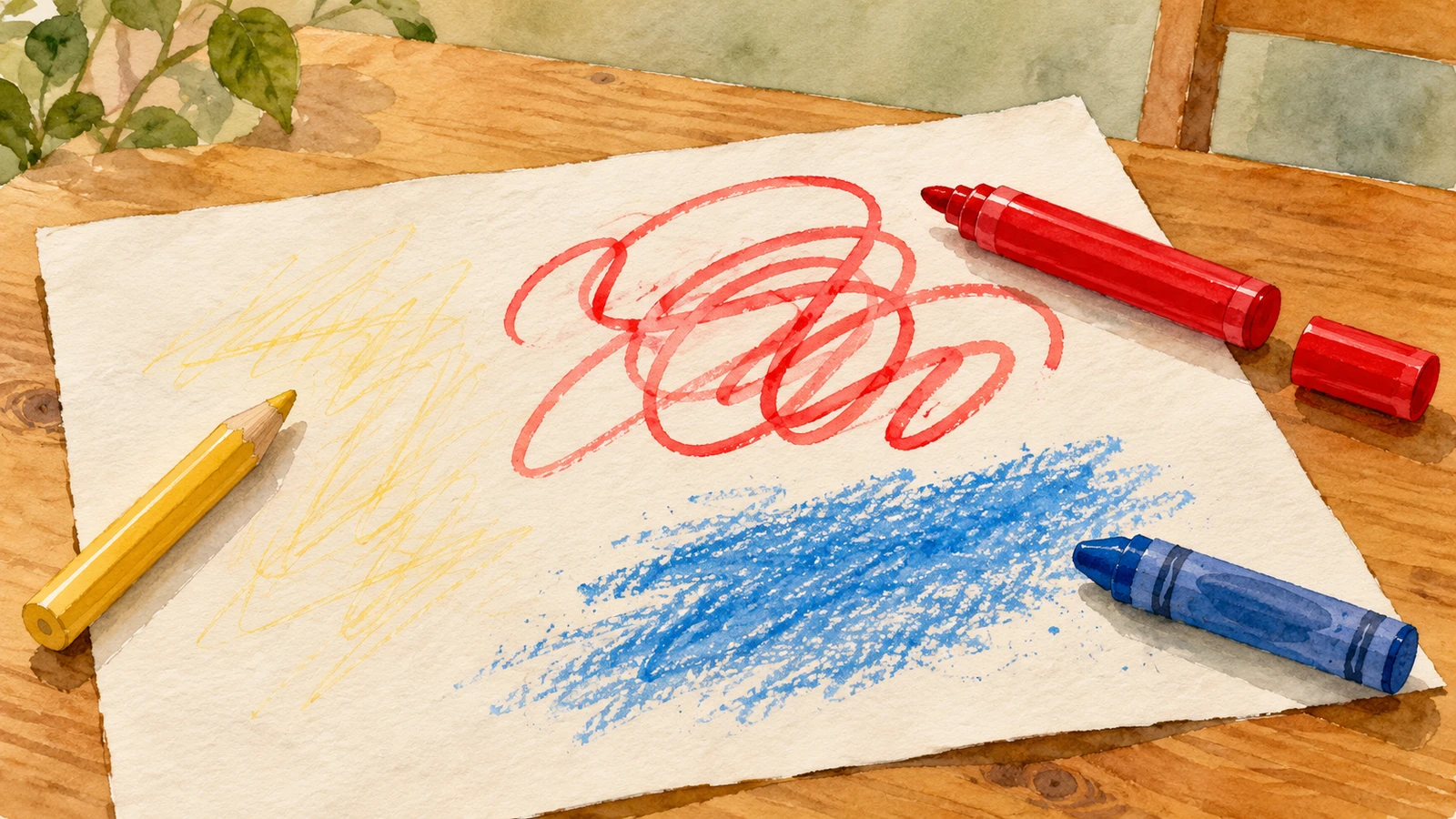
With the pencil, the line stayed faint. Iris pressed harder, then eased off and tried again. With the felt-tip, a big red loop appeared straight away. She added three more around the first.
It was a different movement and a different result. Nora saw the materials as preparation for future skills. Iris was looking at what happened on her paper now.
There was something useful to notice in both. With the pencil, Iris had tried different amounts of pressure; with the felt-tip, she wanted to keep going because the mark was immediately visible. A chunky wax crayon, rubbed on its side, did something else again.
That did not make one the winner. And enjoying a bright colour was not a bad habit to correct.
Offer drawing tools without turning it into an exercise
Nora took two pieces of wax crayon from a box. She laid one on its side on her own sheet to make a blue stripe. Iris tried it, then picked up her felt-tip again.
They did not need a whole collection or a comparison workshop. Two or three tools suitable for Iris’s age, used according to their instructions with an adult watching, could be enough. A large enough sheet and a protected table also made experimenting less tense.
Nora could look at what was getting in the way: a slipping tip, a mark that was too faint, a tired hand. Before deciding that Iris did not like drawing, she could offer something else. As when leaving room for imagination in play, the activity did not have to follow her whole plan.
“Would you like to try this one? It makes a wider mark.”
“You can keep the felt-tip. The pencils are here if you want them.”
Nora did not guide Iris’s fingers into a perfect grip. She moved the tools closer and left the paper alone.
By the end, there were faint lines, red loops and a broad blue stripe. Iris asked for a second sheet and picked up her red felt-tip to carry on drawing.