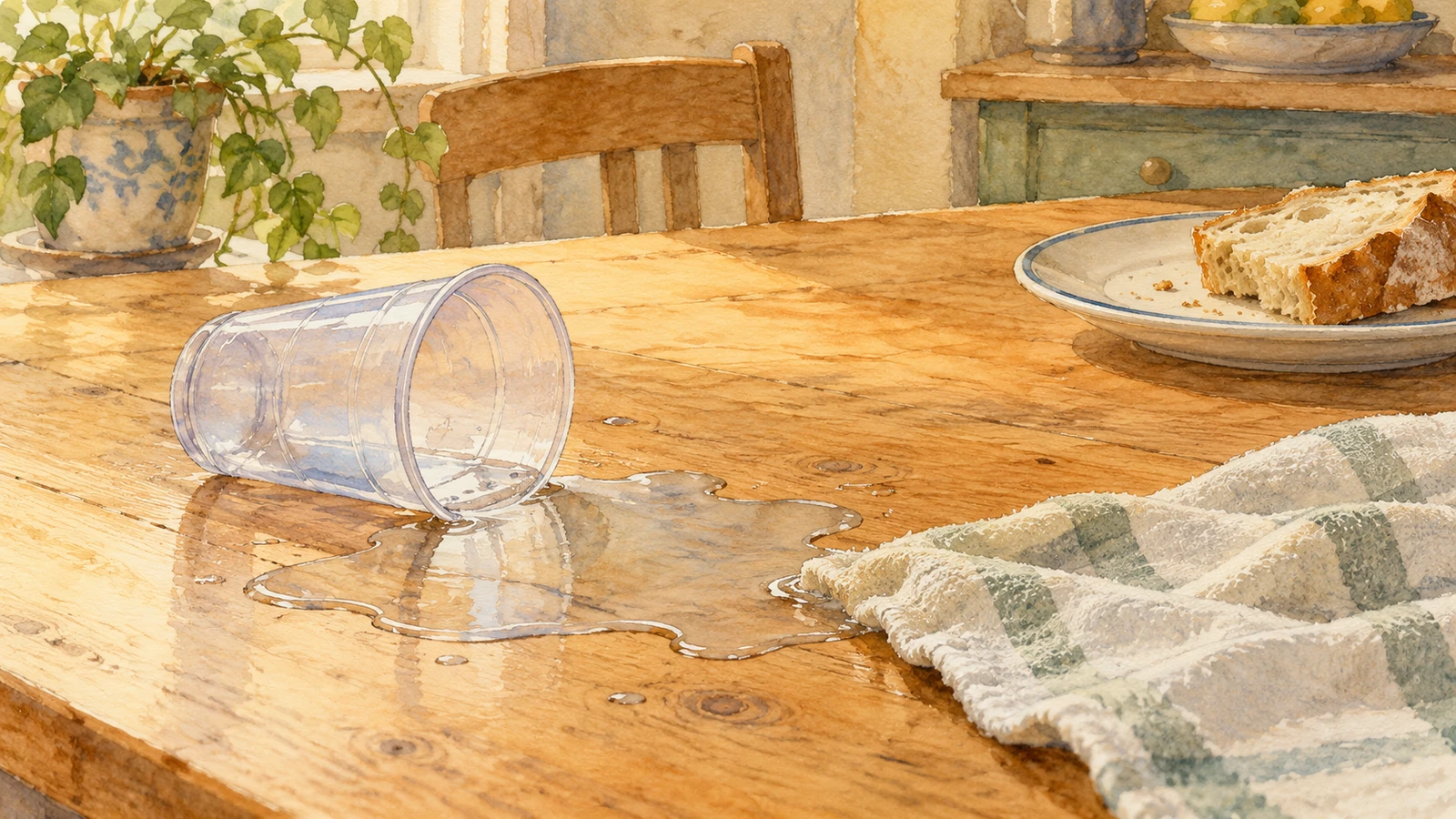
Malo, my almost-three-year-old son, had reached for the bread. His elbow met his cup and water spread beneath the plates.
“Oh, you're clumsy!”
I’d said it while grabbing the cloth, without a speech or any intention of hurting him. But my sentence wasn’t describing the spilled cup. It was describing Malo.
He withdrew his arm and looked at the puddle. The cup was plastic; nothing was broken. We mostly had water to mop up.
The cup fell. The child isn’t an accident
I could be annoyed about the wet tablecloth. I didn’t need to pretend I loved wringing out a cloth during lunch.
But “you are” went beyond the scene. His elbow had caught a cup placed in his path. I’d turned that movement into a summary of the person.
One sentence said too quickly doesn’t tell the story of a whole relationship. We didn’t need a repair ceremony among the plates. I could simply revisit it in front of him.
“I said you were clumsy. I meant that your elbow knocked the cup over.”
Malo looked at his elbow. He raised it carefully, as though we’d just identified the main suspect.
Look for what could help next time
Once the water was mopped up, I looked at the table. The bread was far from him and the cup right in front. I was asking him to reach one without touching the other.
We brought the bread closer and moved the cup to the side. I could also remind him to ask for something to be passed, or give him more room to try.
It wasn’t a guarantee against future accidents. It was more useful than asking him to become a less clumsy person from now on.
I offered him a small cloth for the part he could reach. Not to make him pay for my remark, or prove he was careful. Simply because the water was there and we could deal with it together.
This time, I wanted to stick to what had happened. If the gesture had been deliberate, the boundary could have been about tipping water over. Here, all I’d seen was an elbow meeting a cup.
Malo eventually got the bread. He asked me to hold his cup while he passed the plate.
We hadn’t changed his character over lunch. We’d changed where the cup stood.
Keep this handy
The situation
Your child spills a drink and you call them clumsy without thinking.
Try this
Correct the label you used, describe what actually happened and clean up the small accident together.
- “I called you clumsy, but that wasn't fair. The cup fell.”
- “Let's get a cloth and wipe it up together.”
Keep in mind: You can repair an unhelpful remark without turning it into a big ceremony.