Ever since the storm the day before, five-year-old Louise had been watching the sky warily. When Élodie, her mum, asked if the thunder had frightened her, she shrugged. “No.”
Yet at the first rumble of a lorry in the street, Louise had hurried over to her. Élodie wanted to know what was worrying her, but every new question seemed to close the conversation a little more.
She put a sheet of paper and some crayons on the table, with no instructions beyond, “Fancy doing some drawing?”
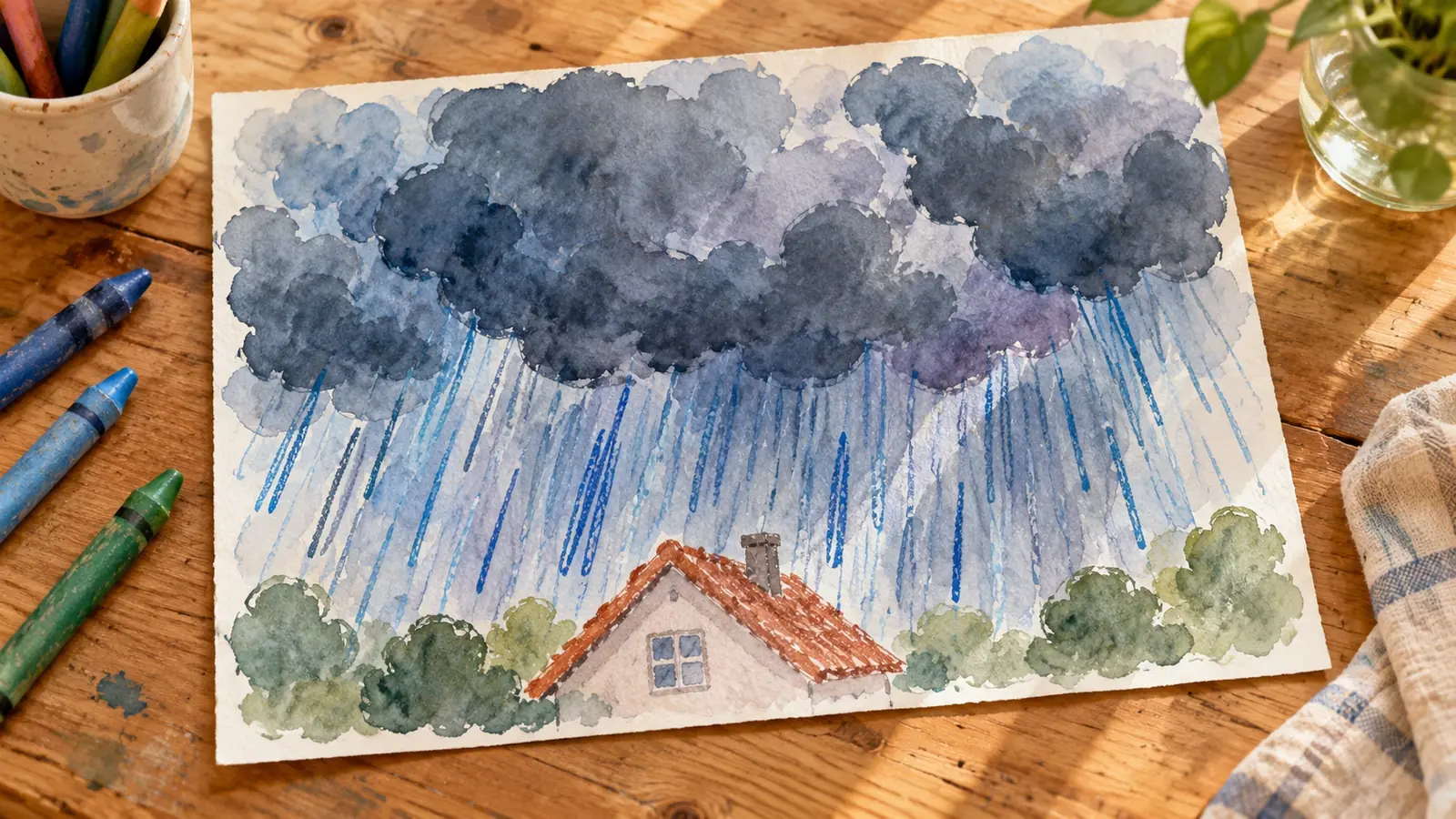
Louise started with a little red roof. Above it she added a grey cloud, then another, then long streaks of rain that almost filled the page. The house looked tiny under the enormous sky.
Élodie was tempted to ask whether the small house was Louise or whether the clouds were her fear. She stopped herself. She couldn’t know what the drawing meant to Louise.
What drawing can offer, without explaining everything
“There’s a lot of rain in your picture,” she simply said.
Louise tapped the window she had drawn. “Yesterday it went boom, and the real window was shaking.”
There it was: a few words Élodie hadn’t managed to get through direct questions. “Yes, it was really loud. It took you by surprise,” she said. Louise drew a yellow flash of lightning, then asked for a green crayon to add grass.
Drawing can give children another way to approach something frightening. But it isn’t a psychological test or a secret message for parents to decode. A dark cloud doesn’t mean the same thing in every picture. Sometimes it is simply the crayon within reach.
Letting her tell the story she wants to tell
Élodie didn’t try to keep the conversation going. She could offer to talk about what had happened, but she didn’t need to insist just because the drawing was finished.
If Louise wanted to return to it, Élodie could use her own words:
“You said the window was moving. Was that what scared you?”
“We can talk about it, or just sit together.”
The next day the weather was bright. Louise got her drawing out, added a sun and went off to play. Élodie didn’t know whether the fear had gone, and that wasn’t the point of the paper.
They had simply found a way to talk, starting with what Louise had wanted to show.
Keep this handy
The situation
Children don’t always want to explain what worries them.
Try this
Was that what scared you?” “We can talk about it, or just sit together.”
- “That frightened you. Do you want to tell me what you imagined?”
Keep in mind: A child's fear can be real even when the imagined danger is not.