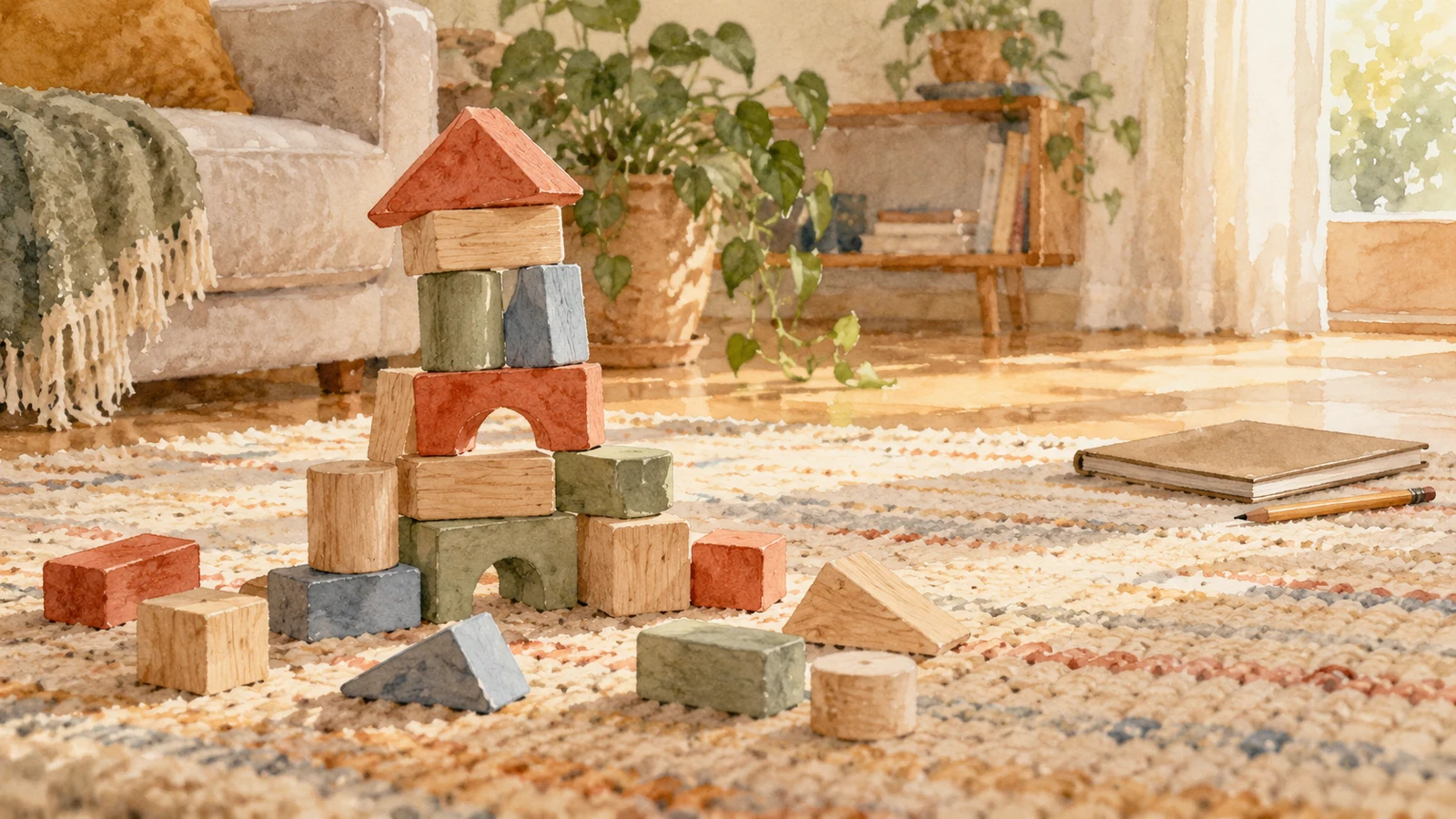
Oscar, four and a half, was stacking blocks on the rug when Julien, his dad, looked at his construction.
Oscar put a block on crookedly. The tower collapsed.
Julien had wanted to recognise the value of his play. In a few seconds, though, he had turned it into a demonstration of skills, with a serious future hidden behind every block. He was already picturing a future architect. Oscar was mainly looking for something to hold up his roof.
When play becomes preparation for the future
Children’s play sometimes reassures us more when we can explain what it is for. Building prepares them for maths, stories develop language, role play practises social relationships. All of that can be true. But when we comment on it constantly, play risks becoming a little job application: every activity should prove that it is preparing them for something.
At three, four or five, a child does not need to know the learning objective of their tower. They can start again because the collapse makes them laugh, change plans because a block suddenly looks like a boat, or abandon the building to put an animal to sleep underneath it. That freedom is itself part of what they are learning.
Watching play without asking it to produce a result
A parent’s role is not to deny that learning happens. We can notice persistence, coordination or imagination without turning them into an expected outcome. Often the difference lies in how we speak.
Instead of asking, “What are you learning?”, we can describe what is happening.
“Your tower fell and you changed the base.”
“You started with a house, then it became a boat.”
“Would you like to tell me your idea or would you rather carry on?”
These phrases let the child decide whether the moment calls for a conversation. They ask for neither an explanation of the process nor proof of progress. A parent’s silence can even give a child time to try, without turning each attempt into a demonstration.
Julien sat a little further away. Oscar rebuilt his house, added a much too heavy roof, then announced that the slug had gone on holiday after all. The tower fell twice more.
Julien resisted the urge to mention engineering. He just asked where the slug had gone. Oscar replied, “To a hotel without a roof, because it’s more practical.”
Oscar put his roof back. Julien watched him do it, without trying to work out what this house might mean for his future.
Keep this handy
The situation
Watching your child play, you are already looking for the skills or future career their game might point towards.
Try this
Notice what your child is doing now. Comment on a detail if it fits the moment, without asking for proof of learning or planning the next step.
- “Would you like me to watch or play with you?”
- “Have you got an idea for what comes next?”
Keep in mind: Educational toys and guided activities have their place too. The idea is to let some play exist without an adult setting its objective.