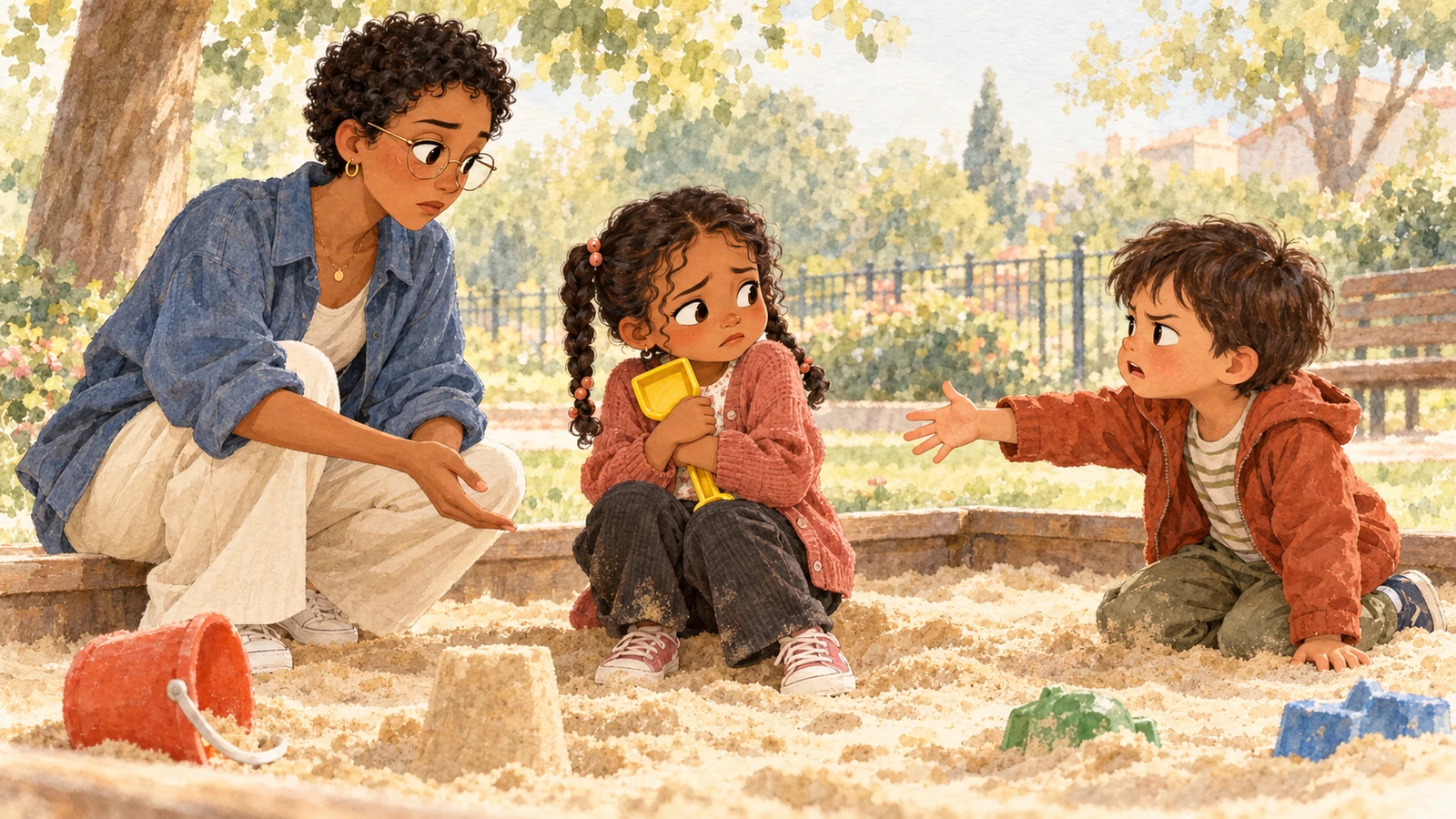
Louise, five, was digging a tunnel when Noé, a friend from the park, asked for her shovel. She wanted to finish. He waited roughly as long as it took to decide he had waited enough.
Élodie, her mum, saw Louise’s fingers loosen around the handle. A moment earlier, she had been defending her building site. Now she was looking at Noé anxiously.
When a child says “I’m not your friend anymore” to get something, the words quickly go beyond the toy. The shovel had become the price of carrying on playing together.
A threat about friendship is not a request
Élodie wanted to tell Louise that a real friend would never do that. And to tell Noé not to blackmail people. That would have settled two very serious questions between a tunnel and an overturned bucket.
But at this age, such strong words can be a clumsy attempt to regain control when other words are missing. That does not make their effect harmless: Louise was ready to hand over the shovel although she still needed it.
Élodie could therefore stop the pressure without deciding that Noé was a manipulative child. He wanted the shovel. He could ask differently. Louise did not have to prove her friendship by immediately giving up what she was doing.
The question of sharing and taking turns still needed sorting out, without making the relationship depend on the answer.
Help them respond without demanding a reconciliation
Élodie came closer. She described the problem to both children: Noé wanted to dig, Louise had not finished and the threat frightened her.
She promised neither that they would remain friends forever nor that Noé would calmly accept waiting. A child can also choose to play elsewhere. But we can help them express what they want without threatening someone else.
To the child hearing the words, then the one saying them, we might suggest:
“You can keep the shovel while you finish. You’re allowed to say no, even if you’re afraid he’ll get cross.”
“You want the shovel. You can ask: ‘Will you pass it to me when you’ve finished?’”
If these threats keep happening, with exclusion or fear of joining the group, help involves more than a good reply: the adults supporting the children need to look at the pattern.
Noé protested, then picked up the bucket. Louise kept the shovel to finish her tunnel. When Noé asked her to fill his bucket, Louise pointed to the tunnel she still needed to finish. Élodie stayed nearby while they worked out what came next.
Keep this handy
The situation
Another child threatens to withdraw their friendship to get a toy and your child considers giving in for fear of losing the relationship.
Try this
Describe the disagreement, support the right to refuse and help the other child make a request without a threat. Stay available to help with what happens next.
- “You want to stay with him and you still need the toy.”
- “How could you ask for what you want without frightening her?”
Keep in mind: Repeated threats, exclusion or fear of joining the group call for a conversation with the adults who look after the children.