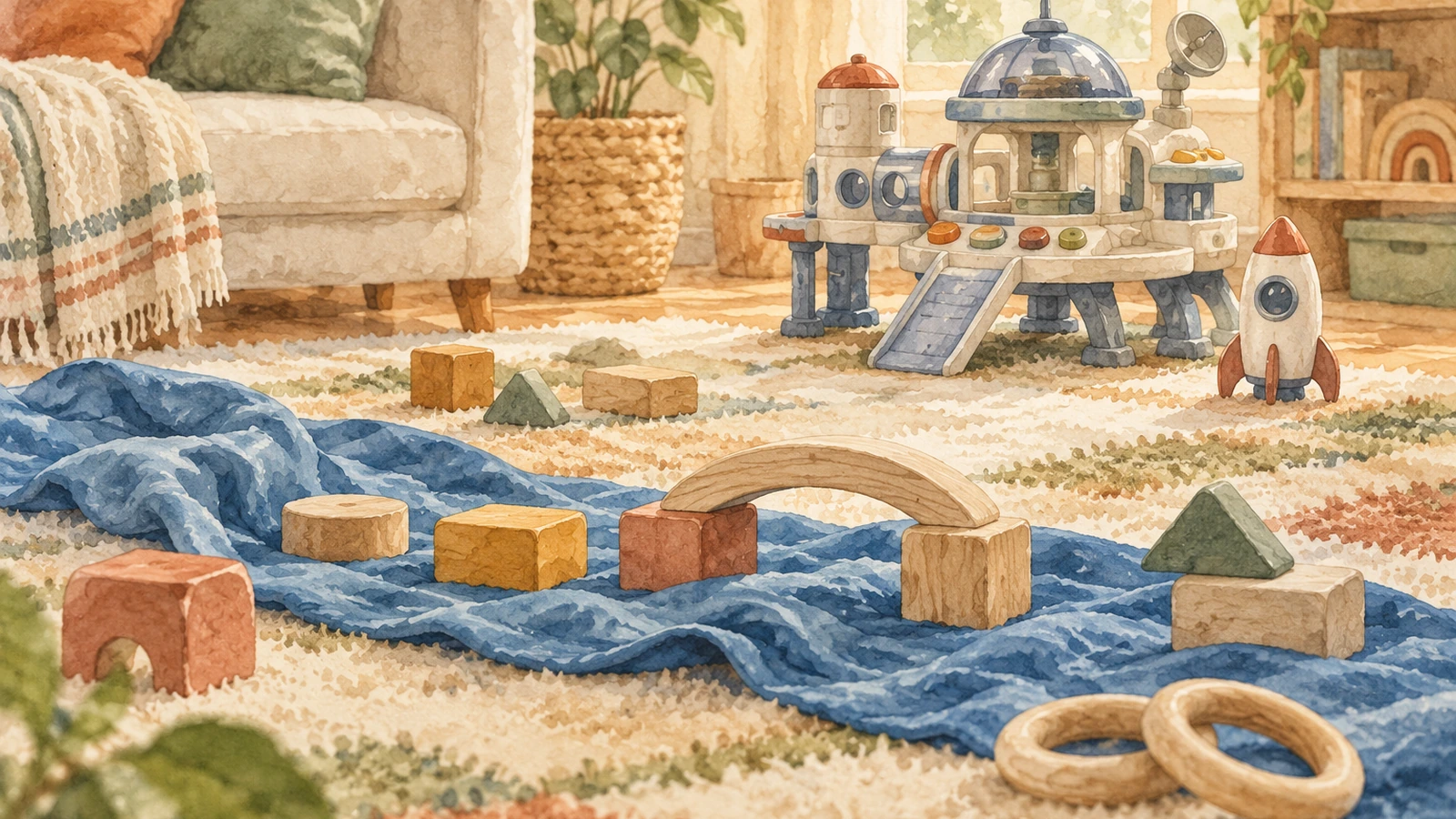
Malo, nearly three, watched his mum, Camille, remove the last ties from the packaging. The space station lit up, counted down to launch and spun its little rocket. He carefully pressed every button.
By the third launch, he had gone to find a blue cloth and two large wooden rings.
Camille looked at the new toy, then at the cloth spread across the walkway. She had already imagined a whole afternoon around that station. Her child had just opened a river in the living room.
A sophisticated toy: lots of features, few decisions?
A sophisticated toy can offer a delightful show: a light, a noise or an action that starts again. But in some games, the child mainly chooses which button will trigger an already planned sequence.
The cloth offered nothing so impressive. Yet Malo could decide it was a river, fold it into a bed or ask Camille to hold one end. The object changed roles as his story moved on.
What held his attention that afternoon was not an extra feature. It was the possibility of doing something different with the same objects.
Camille put a block beside the cloth. Malo moved it: it was a stepping stone, not a house. Apparently the adults had not received the right instructions either.
Looking at what the child can still invent
That did not make the space station bad or every simple toy fascinating. A child can love a predictable sequence, and a complex toy can leave plenty of freedom. Price, material and the number of batteries do not settle the question.
So the issue was not just whether a toy was electronic or screen-free. Camille could look at what Malo still decided once it was switched on: changing the story, moving the pieces, giving them another use or combining them with other objects.
Before buying something, that may be more useful than counting the features on the box. With a toy already at home, we can watch what the child does, try it without sound if possible or leave a few objects nearby for them to use in their own way.
There is no need to restart the game every minute with an adult idea. If the child changes plans, that detour is part of play too.
Camille left the station on the floor. Later, Malo put the rocket on the cloth: it needed to cross the river, but it could not swim.
This time, no button supplied what happened next. Camille asked where the bridge was.
Keep this handy
The situation
Your child leaves a toy packed with features and turns simple objects into a new game.
Try this
Watch what they can change, repurpose and combine. Before buying, look at play possibilities; with a toy already at home, leave room for unexpected uses.
- “What would you like to do with it?”
- “You can use it another way too.”
Keep in mind: Predictable sequences have their appeal too. A complex toy can offer freedom, and a simple object will not interest every child.