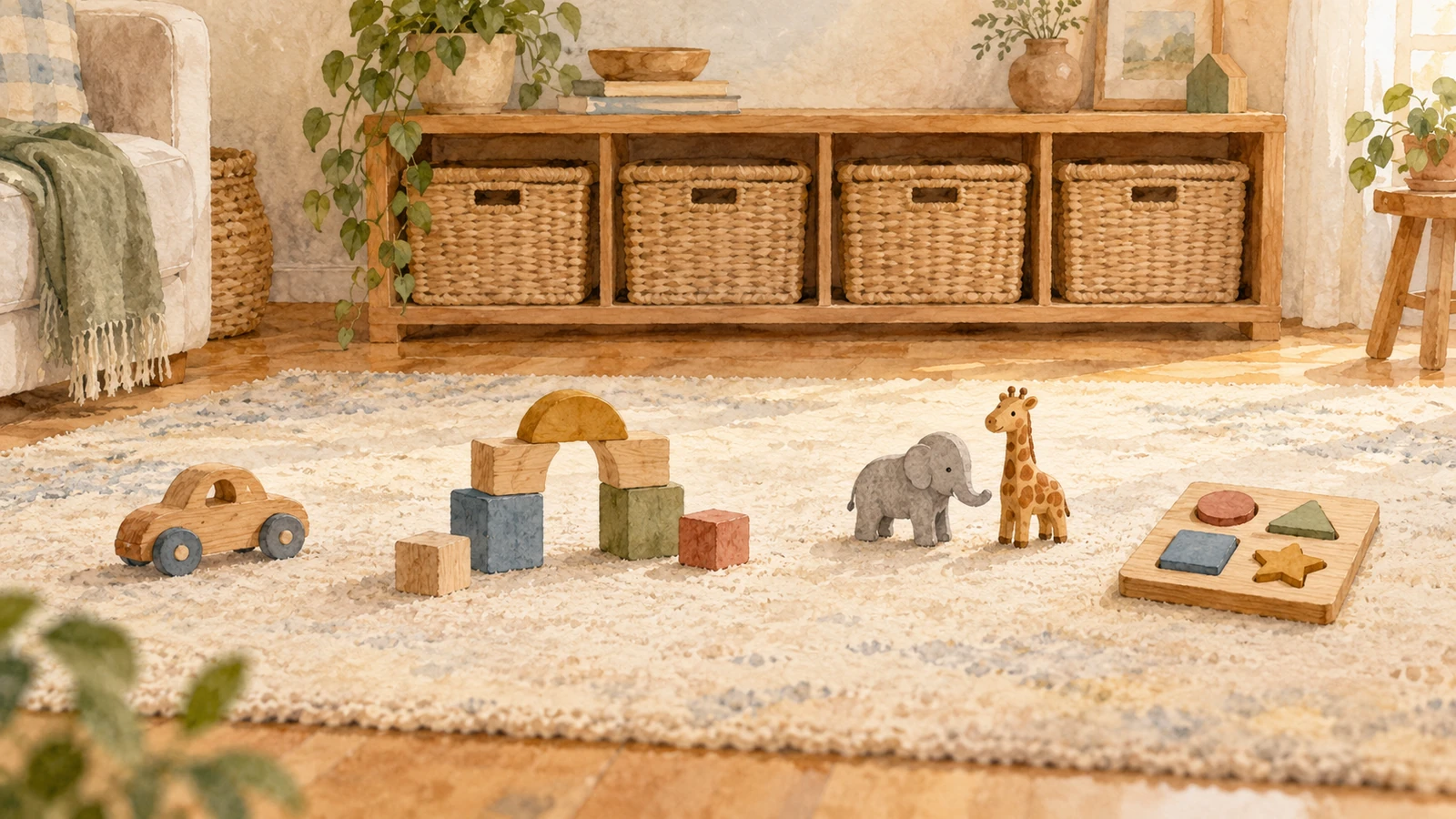
Julien had brought out a tub of cars, the blocks, the animals, a puzzle and two boxes of craft supplies. He thought he was giving Oscar, his four-and-a-half-year-old son, a whole morning of possibilities.
Oscar picked up a car. Then a block. Then the lid of the felt-tip pens. He asked for the puzzle, abandoned it before the second piece and sat down in the middle of the rug saying he did not know what to do.
Julien had a thought that was rather unfair to all the toys around him: with everything you have, surely you could play.
It is a familiar bug. When a child does not play on their own, our first instinct is sometimes to add an activity or make more toys available. Yet more choice does not always create more momentum. At this age, seeing everything, opening everything and deciding everything can already become an activity in itself.
There is no magic number
The problem was not that Oscar owned “too many” toys in any absolute sense. Some children move happily between different worlds. Others need fewer things competing for their attention to stay with an idea.
So Julien did not organise a grand, morally charged clear-out on a Saturday morning. He simply left four options on the rug and put the rest in closed baskets. The car came back. Then a tunnel made of blocks. Then the animals waited outside the tunnel.
Nothing spectacular: the game had simply had time to begin.
That difference matters. Reducing what is visible does not mean throwing things away, buying perfect storage boxes or turning a bedroom into a minimalist catalogue. You can rotate a few toys, keep favourites within reach and watch what actually helps your child stay with their story.
Put a little away without deciding everything for them
Tidying can quickly become another trap. If an adult makes things disappear in secret, the child may mainly learn that their belongings never quite belong to them. It is better to start small, with changes that can be reversed.
“We’re keeping four toys here today. Which one absolutely has to stay?”
“The others are waiting in this basket. We can swap them tomorrow.”
“Are you still playing with this one, or would you like to give it a break?”
With a two-year-old, choosing just one favourite may be enough. At five, a child can take more of a part in rotating toys. And on tired days, opening every tub is still allowed: it is not a parenting failure.
That morning, Julien did not find the perfect quantity. He simply stopped confusing abundance with availability. Oscar had fewer toys in front of him, but more room to invent.
Keep this handy
The situation
Your child keeps moving between toys without settling into play.
Try this
Temporarily reduce the toys on display with your child's involvement, then offer to swap them when they want.
- “Shall we keep a few here and put the others in a basket for later?”
- “Would you like to swap a toy from the basket for this one?”
Keep in mind: Toy rotation should be flexible and reversible, not a punishment or a perfect number to achieve.